
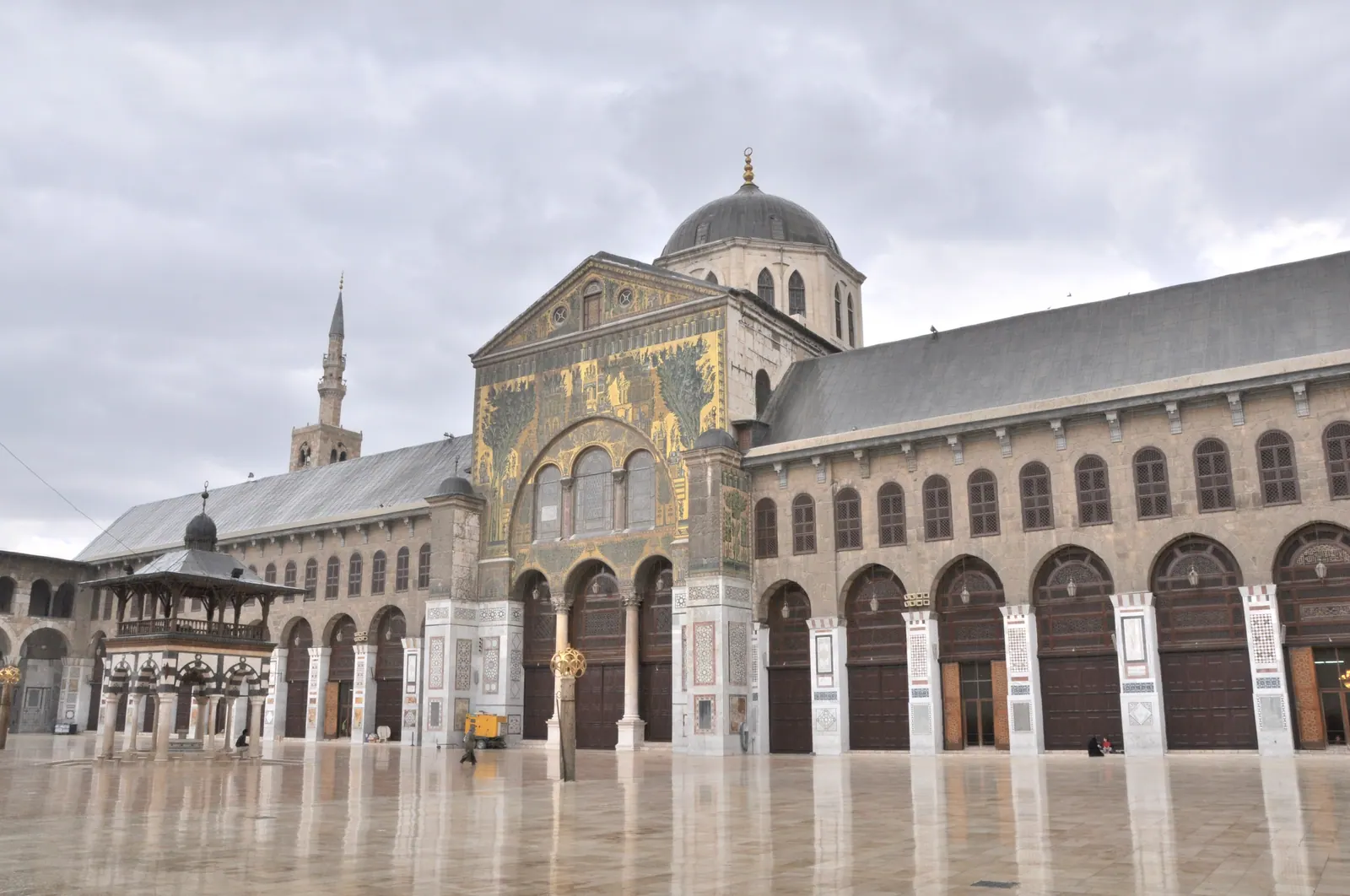
CSC_0190 · Photo: Lazhar Neftien from Toulouse, France · CC BY 2.0 · Wikimedia Commons · Recorded 2009
Umayyad Mosque
Local name: جامع بني أمية الكبير
The Umayyad Mosque in the old city of Damascus is one of the largest and oldest mosques in the world and is considered the oldest mosque still in use in its original form. Caliph al-Walid I had it built from 706 on the site of a Byzantine cathedral, which itself stood within the precinct of a Roman temple of Jupiter. As part of the Ancient City of Damascus it has been on the UNESCO World Heritage List since 1979.
History
The site has been a place of worship since the Iron Age. The Arameans built a temple here to the storm god Hadad-Ramman; one stone from the reign of King Hazael survives in the National Museum of Damascus. Under the Seleucids the sanctuary was probably dedicated to Zeus, and after the Roman conquest in 64 BC to Jupiter, becoming the largest temple in Roman Syria. In 391 Emperor Theodosius I converted it into a cathedral, the seat of the Bishop of Damascus.
After the Muslim conquest (634 according to the English Wikipedia, 636 according to the German) a prayer room for Muslims was set up in the south-eastern part of the building. In 706 al-Walid I decided to build a congregational mosque, demolished most of the church and returned other confiscated churches to the Christians in compensation. Completion is dated to 711 or 715, the latter under his successor Sulayman. According to Ibn al-Faqih, 600,000 to 1,000,000 gold dinars were spent and some 12,000 people worked on it.
Fires in 1069, 1401 (under Timur, when the central dome collapsed) and 1893, together with the earthquakes of 1759, repeatedly forced rebuilding; the Mamluks, notably Baybars from 1270, were especially active restorers. After 1893 the Ottomans spent nine years rebuilding the prayer hall, largely keeping the plan but not reproducing the original decoration.[1][2]
Architecture
The rectangular enclosure measures about 97 by 156 metres (157 by 97 in the German Wikipedia); its outer walls are those of the Roman temple precinct. The courtyard lies to the north, the 136-by-37-metre prayer hall to the south, with three aisles parallel to the qibla wall on Corinthian columns, crossed by a higher central transept. Above it rises the Dome of the Eagle (Qubbat an-Nisr), rebuilt in stone after 1893; its height is given as 36 metres (English article) or over 45 metres (German and Arabic).
Gold mosaics once covered some 4,000 square metres, showing landscapes and buildings but no human or animal figures; the best-preserved remains are in the courtyard. There are three minarets: the Minaret of the Bride on the north wall (lower part probably 9th century, top 1174), the roughly 77-metre Minaret of Isa in the south-east (main body 1247, top Ottoman) and the octagonal Minaret of Qaitbay of 1488 in the south-west.[1][2][3]
Use and significance
The site served Aramean, Greek and Roman cults, then as a Christian cathedral, and from the 8th century as the city's Sunni congregational mosque. It was also a centre of learning: Ibn Taymiyya taught here from 1285, and the astronomer Ibn al-Shatir was timekeeper and chief muezzin from 1332 to 1376. Under the Ottomans its waqf, with 596 employees, was the city's largest, and its preacher one of the most influential officials of Damascus.
Christian and Muslim tradition alike, dating back to the 6th century, place the head of John the Baptist (Yahya) here; a shrine in the prayer hall is venerated by both. On 6 May 2001 Pope John Paul II prayed there, the first papal visit to a mosque. Two shrines commemorate Husayn ibn Ali, grandson of the Prophet; according to the German article, the one said to hold his head is an important Shia pilgrimage site. Islamic tradition links the Minaret of Isa with the descent of Jesus at the end of time.
Politically, the mosque repeatedly served as a rallying point, against the Crusaders in 1148 and for the first significant Arab Spring protests in Syria on 15 March 2011.[1][2]
Notable features
Its plan of three aisles and a transept shaped mosques far beyond Syria, including Córdoba and al-Azhar in Cairo. A 2022 study concluded that most mosaic tesserae were made in Egypt; whether the imagery depicts Paradise, Damascus or the known world remains debated.[1]
Timeline
- 391
Theodosius I converts the Temple of Jupiter into a cathedral.[1][3]
- 634 (or 636)
Muslim conquest of Damascus; a Muslim prayer room is set up in the south-eastern part of the cathedral.[1][2][3]
- 706–711/715
Construction of the congregational mosque under al-Walid I; completed in 711 or 715.[1][3]
- 1069
A fire during an uprising against the Fatimid garrison destroys large sections, especially the north wall.[1][3]
- 1401
Timur has the city burned; the eastern minaret and central dome collapse.[1][3]
- 1488
- 1893
Fire destroys the interior of the prayer hall; nine-year Ottoman rebuilding follows.[1][3]
- 2001
Pope John Paul II visits the shrine of John the Baptist, the first papal visit to a mosque.[1][2][3]
Gallery
Documented condition
Preserved · as of 2026-10-30
Source of the status: Wikipedia infobox 'active' (retrieved 2026-10-30)
The sources document no damage after 1994, when the renovation ordered by Hafez al-Assad, whose methods UNESCO criticised, was completed. The Ancient City of Damascus as a whole has been on the List of World Heritage in Danger since 2013.[1][3][4]
Visiting
Getting here
Documented ride, stay and transport services in Damascus:
Nearby medical services
Straight-line distance from this place. Data: OpenStreetMap, as of 2026-10-30. Operating status not verified – call before going.
- مشفى الغزاليHospital · 0.9 kmDirections
- مركز الإغاثة والتنمي أر دي سيHospital · 1 kmDirections
- HospitalHospital · 1 kmDirections
- المشفى السوري التخصصي لأمراض جهاز الهضمHospital · 1 kmDirections
- Red CrescentHospital · 1 kmDirections
- مشفى الهلالHospital · 1 kmDirections
Sources (23)
- Wikipedia (en): Umayyad Mosque rev. 1381848245 · CC BY-SA 4.0 · 2026-10-30
- Wikipedia (de): Umayyaden-Moschee rev. 268196143 · CC BY-SA 4.0 · 2026-10-30
- Wikipedia (ar): الجامع الأموي (دمشق) rev. 76953549 · CC BY-SA 4.0 · 2026-10-30
- UNESCO World Heritage Centre: Ancient City of Damascus · 2026-10-30
- Wikidata · CC0 · 2026-10-30
- Wikipedia (el) · CC BY-SA 4.0 · 2026-10-30
- Wikipedia (es) · CC BY-SA 4.0 · 2026-10-30
- Wikipedia (fa) · CC BY-SA 4.0 · 2026-10-30
- Wikipedia (fr) · CC BY-SA 4.0 · 2026-10-30
- Wikipedia (hi) · CC BY-SA 4.0 · 2026-10-30
- Wikipedia (id) · CC BY-SA 4.0 · 2026-10-30
- Wikipedia (it) · CC BY-SA 4.0 · 2026-10-30
- Wikipedia (ja) · CC BY-SA 4.0 · 2026-10-30
- Wikipedia (ko) · CC BY-SA 4.0 · 2026-10-30
- Wikipedia (nl) · CC BY-SA 4.0 · 2026-10-30
- Wikipedia (pl) · CC BY-SA 4.0 · 2026-10-30
- Wikipedia (pt) · CC BY-SA 4.0 · 2026-10-30
- Wikipedia (ru) · CC BY-SA 4.0 · 2026-10-30
- Wikipedia (sv) · CC BY-SA 4.0 · 2026-10-30
- Wikipedia (tr) · CC BY-SA 4.0 · 2026-10-30
- Wikipedia (ur) · CC BY-SA 4.0 · 2026-10-30
- Wikipedia (zh) · CC BY-SA 4.0 · 2026-10-30
- OpenStreetMap · ODbL · 2026-10-30
Abweichende Angaben: Eroberung 634 (en/ar) vs. 636 (de); Fertigstellung 711 oder 715 (en), Bau 708–715 (de), Baubeginn 705 (ar); Maße 156 vs. 157 m; Kuppelhöhe 36 m (en) vs. über 45 m (de/ar); römische Eroberung 64 v. Chr. (en) vs. 64 n. Chr. (ar). Zum aktuellen baulichen Zustand nach 2011 liefern die Quellen keine Angaben.