
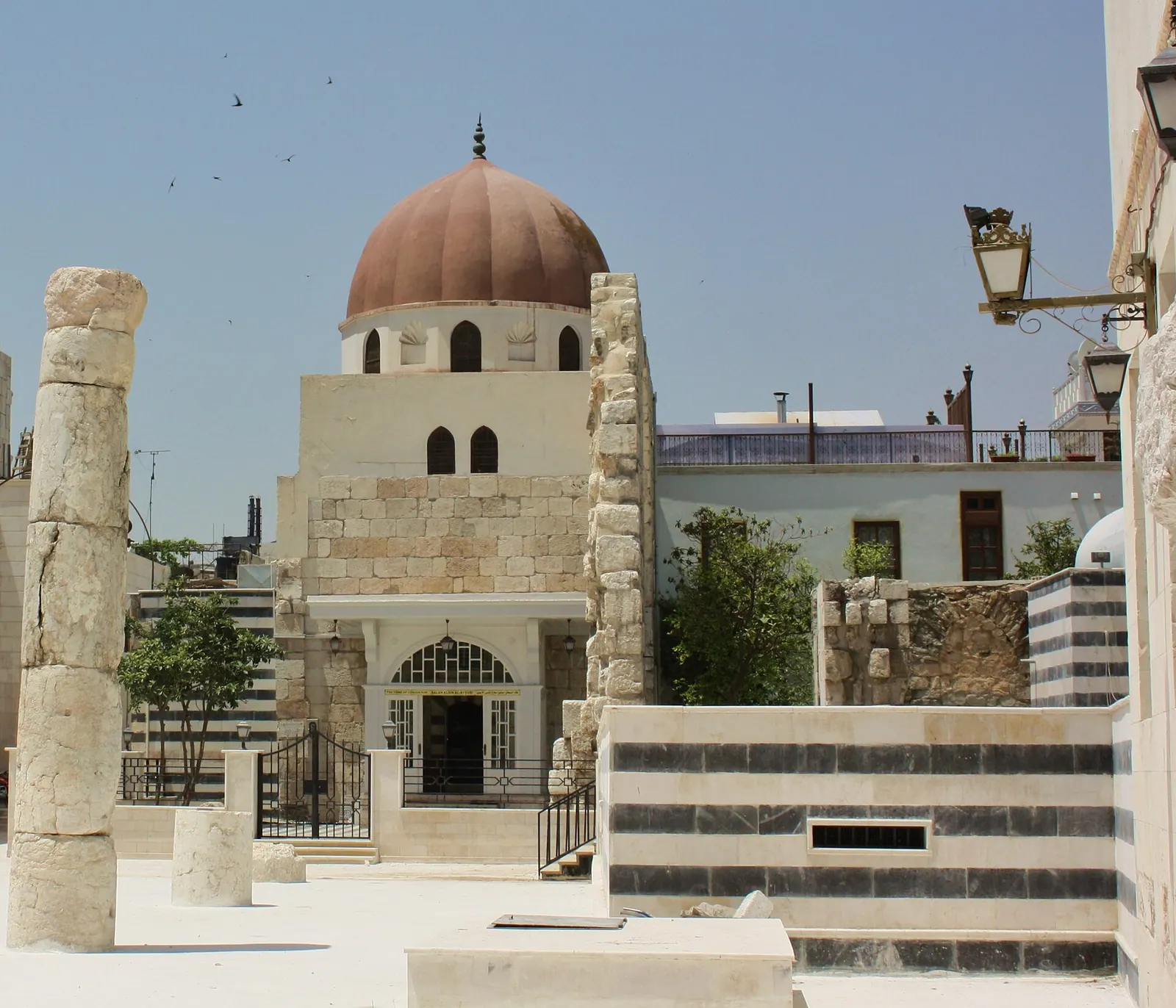
Saladin mausoleum in Damascus · Photo: Jan Smith · CC BY 2.0 · Wikimedia Commons · Recorded 2010
Mausoleum of Saladin
Local name: ضريح صلاح الدين الأيوبي
The Mausoleum of Saladin is the burial place of the Ayyubid sultan Saladin, on the north side of the Umayyad Mosque in the old city of Damascus. The domed tomb was built shortly after Saladin's death in 1193; of the adjoining al-Aziziyya Madrasa only remains survive.
History
Saladin died in Damascus on 4 March 1193 and was first buried in the Citadel. According to the Arabic Wikipedia his son al-Afdal bought a house in the al-Kallasa quarter near the Umayyad Mosque and built a domed tomb there; the remains were transferred in 592 AH (1195). The English Wikipedia gives 1196 as the year of construction. Another son, al-Aziz Uthman, added the al-Aziziyya Madrasa east of the dome in 593 AH according to the Arabic Wikipedia, and the building is also known by that name.
According to the Arabic Wikipedia the walls were faced with blue tiles in 1137 AH, and in the early 20th century the Ottoman governor Ziya Pasha turned the ruined madrasa into a garden. Emperor Wilhelm II visited the tomb in 1898 during his journey to the Orient and had a wreath laid there, which after the First World War went to the Imperial War Museum; the English Wikipedia says it was removed by either Faisal I or T. E. Lawrence.[1][2][3]
Architecture
The mausoleum is a domed building of a type typical of Ayyubid Damascus. The square tomb chamber has ablaq walls and is covered by four arches and a ribbed dome, with a two-stage drum of eight and sixteen sides forming the transition. A room for Quran recitation lies to the east, smaller rooms to the north. Of the madrasa, the Arabic Wikipedia says the mihrab and the arch of the eastern entrance remain, the English Wikipedia a few columns and an internal arch.
Two sarcophagi stand inside. The older wooden cenotaph (walnut, according to the Arabic Wikipedia), carved with geometric and floral motifs and Ayyubid inscriptions, is said to contain Saladin's remains. Beside it is an empty white marble sarcophagus of around 1900; the German and Arabic Wikipedia describe it as a gift of Wilhelm II in 1898, while the English Wikipedia attributes it to Sultan Abdul Hamid II and says Wilhelm II later restored it. The walls carry blue-green Ottoman tiles; according to the Arabic Wikipedia the tiled panel, 475 by 238 centimetres, is the largest complete arched panel of its kind in Damascus.[1][2][3]
Use and significance
The mausoleum is among the best-known medieval Islamic tombs in Syria and in the late 19th century became a site of symbolic politics of memory. According to the Arabic Wikipedia its garden holds five further graves: that of the Syrian politician Abd al-Rahman Shahbandar, assassinated in 1940; that of Yasin al-Hashimi, twice prime minister of Iraq, who died in Damascus in 1937; and those of three Ottoman aviators who had landed in Damascus in January 1914 and later crashed.[2][3]
Timeline
- 1193
Saladin dies in Damascus and is first buried in the Citadel.[2][3]
- 1195/1196
Transfer to the mausoleum built by al-Afdal (592 AH = 1195 per German/Arabic sources; built 1196 per English Wikipedia).[1][2][3]
- 593 AH
Al-Aziz Uthman adds the al-Aziziyya Madrasa (per Arabic Wikipedia).[3]
- 1898
Visit of Emperor Wilhelm II; wreath laid, marble sarcophagus donated (German/Arabic sources).[2][3]
- early 20th c.
Governor Ziya Pasha turns the ruined madrasa into a garden.[3]
- 2000s
Restoration of the square around the tomb (per Arabic Wikipedia).[3]
Gallery
Documented condition
Preserved · as of 2026-10-30 Historically documented
Source of the status: Wikipedia (no damage reported)
According to the Arabic Wikipedia the square around the tomb was restored in the 2000s. No more recent condition report is available. The mausoleum lies within the old city of Damascus, for which UNESCO names the city walls, the Citadel and some mosques and tombs as surviving medieval buildings.[3][4]
Visiting
Getting here
Documented ride, stay and transport services in Damascus:
Nearby medical services
Straight-line distance from this place. Data: OpenStreetMap, as of 2026-10-30. Operating status not verified – call before going.
- مشفى الغزاليHospital · 0.8 kmDirections
- HospitalHospital · 0.9 kmDirections
- المشفى السوري التخصصي لأمراض جهاز الهضمHospital · 1 kmDirections
- Red CrescentHospital · 1 kmDirections
- مشفى الهلالHospital · 1 kmDirections
- مشفى العين والاذنHospital · 1 kmDirections
Sources (12)
- Wikipedia (en): Mausoleum of Saladin rev. 1353602595 · CC BY-SA 4.0 · 2026-10-30
- Wikipedia (de): Mausoleum Saladins rev. 268231625 · CC BY-SA 4.0 · 2026-10-30
- Wikipedia (ar): ضريح صلاح الدين الأيوبي rev. 72564206 · CC BY-SA 4.0 · 2026-10-30
- UNESCO World Heritage Centre: Ancient City of Damascus · 2026-10-30
- Wikidata · CC0 · 2026-10-30
- Wikipedia (es) · CC BY-SA 4.0 · 2026-10-30
- Wikipedia (fa) · CC BY-SA 4.0 · 2026-10-30
- Wikipedia (hi) · CC BY-SA 4.0 · 2026-10-30
- Wikipedia (it) · CC BY-SA 4.0 · 2026-10-30
- Wikipedia (pt) · CC BY-SA 4.0 · 2026-10-30
- Wikipedia (ur) · CC BY-SA 4.0 · 2026-10-30
- OpenStreetMap · ODbL · 2026-10-30
Widersprüche: (1) Baujahr – en 1196 ('drei Jahre nach Saladins Tod'), Wikidata-Inception 1196; de/ar Überführung 592 H. = 1195. (2) Marmorsarkophag – en: von Abdülhamid II. errichtet, von Wilhelm II. restauriert; de/ar: Geschenk Wilhelms II. 1898. (3) Kranz – de: von Wilhelm II. niedergelegt, nach dem Ersten Weltkrieg ins Imperial War Museum; en: von Faisal I. oder Lawrence entfernt. (4) Fliesen – de: 17. Jh.; ar: Verkleidung 1137 H. – Datierungen nicht abgeglichen, im Text getrennt wiedergegeben. (5) Reste der Madrasa – en: Säulen und Innenbogen; ar: Mihrab und östlicher Eingangsbogen. (6) Holz-Kenotaph – en: 'soll' die Gebeine enthalten. Anekdote über General Gouraud (nur ar, ohne Beleg) nicht übernommen. Q-ID Q183562 (Umayyaden-Moschee) aus dem bestehenden Redaktionsdatensatz; Q3678596 aus Wikidata P361, Label nach UNESCO-Seite – bitte prüfen. Einschreibungsjahr der Welterbestätte nicht im Paket.