
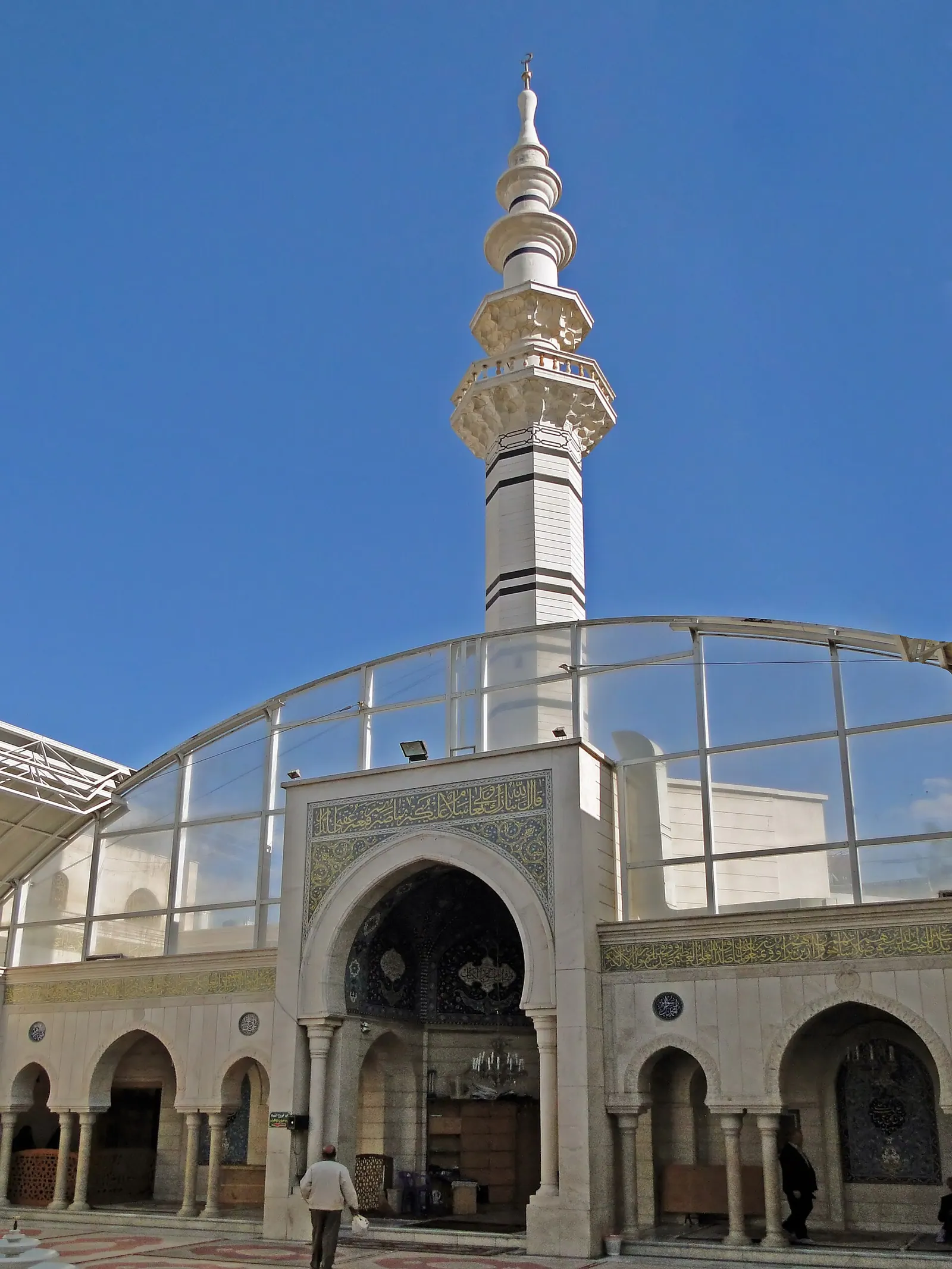
Minaret of the Sayyidah Ruqayya Mosque, Damascus, Syria · Photo: Bernard Gagnon · CC BY-SA 3.0 · Wikimedia Commons · Recorded 2010
Sayyidah Ruqayya Mosque
Local name: مقام رقية بنت الحسين
The Sayyida Ruqayya Mosque is a Shia mosque and mausoleum complex in the al-Amara district of central Damascus. It holds the grave of Ruqayya bint Husayn, the young daughter of Imam Husayn, and is a holy site in Shia Islam. The present building, in a modern Iranian style, was raised around an older tomb in about 1980–1985.
History
According to Shia tradition, Ruqayya was the youngest daughter of Husayn, by his wife Umm Ishaq according to the Arabic Wikipedia. She witnessed the Battle of Karbala in 680 and was then taken with the captive women and children to Yazid in Damascus, where they were lodged in a ruin near his palace. When the child woke at night crying for her father, Yazid had his head brought to her; she died soon after, on 7 Safar 61 AH according to the Arabic article, aged three or four, and was buried on the spot. The English Wikipedia relates a tradition that her body was later moved to the present site after her grave was flooded.
The Arabic Wikipedia attributes a first structure over the grave to an Ayyubid sultan in 526 AH, followed by a small dome in 768 AH. Renovations are recorded for 1280 AH (elsewhere in the same article 1125 AH) and 1323 AH, the latter by Ali Asghar Khan, grand vizier of Iran. From 1399 AH (1980) the shrine, until then no larger than 60 square metres, was expanded over several years into a complex of about 4,000 square metres; the English Wikipedia dates the building of the mosque around the mausoleum to 1985.[1][2]
Architecture
The new building follows a Persian-influenced style with marked symmetry, extensive mirror and gold work and tilework, while keeping elements of Islamic architecture such as a courtyard, arcades and ornament. It encloses the grave and the old dome, with a prayer area, an ambulatory and a courtyard of about 600 square metres alongside. A ribbed dome rises over the tomb. The cenotaph is surrounded by a new shrine screen (zarih), made according to the Arabic article by forty craftsmen and inscribed with hadith and verse. Gilded poems, including one by Mustafa Jamal al-Din, run around the grave.[1][2]
Use and significance
The complex serves as a place of prayer and above all as a Shia pilgrimage site, visited by tens of thousands according to the English Wikipedia. Commemorations are held especially in Muharram and Safar, and Ruqayya's story is recalled each year at Ashura. For Shia Muslims she stands for the suffering of the Prophet's family after Karbala. The Arabic Wikipedia names pilgrims from Iran, Iraq, the Gulf states, Lebanon and Pakistan, as well as foreign delegations coming to see its Islamic architecture and heritage.[1][2]
Notable features
Timeline
- 680 (61 AH)
Battle of Karbala; according to Shia tradition Ruqayya subsequently dies in captivity in Damascus.[1][2]
- 526 AH
First structure over the grave, attributed to an Ayyubid sultan.[2]
- 768 AH
A small dome is built over the tomb.[2]
- 1323 AH
Renovation by Ali Asghar Khan, grand vizier of Iran.[2]
- 1980 (1399 AH)
Expansion into a complex of about 4,000 m² begins.[2]
- 1985
The mosque is built around the mausoleum (per the English Wikipedia).[1]
Gallery
Documented condition
Preserved · as of 2026-10-30 Attributed by tradition
Source of the status: Wikipedia (active pilgrimage site)
The sources used contain no dated information on damage or restoration after the expansion of the 1980s. The English Wikipedia mentions, without a date, construction work connected with the war.[1][2]
Visiting
Getting here
Documented ride, stay and transport services in Damascus:
Nearby medical services
Straight-line distance from this place. Data: OpenStreetMap, as of 2026-10-30. Operating status not verified – call before going.
- مشفى الغزاليHospital · 0.7 kmDirections
- HospitalHospital · 0.8 kmDirections
- المشفى السوري التخصصي لأمراض جهاز الهضمHospital · 0.8 kmDirections
- Red CrescentHospital · 0.8 kmDirections
- مشفى الهلالHospital · 0.8 kmDirections
- Saint Louis HospitalHospital · 1 kmDirections
Sources (8)
- Wikipedia (en): Sayyida Ruqayya Mosque rev. 1380194322 · CC BY-SA 4.0 · 2026-10-30
- Wikipedia (ar): مقام رقية بنت الحسين rev. 72661124 · CC BY-SA 4.0 · 2026-10-30
- Wikidata · CC0 · 2026-10-30
- Wikipedia (fa) · CC BY-SA 4.0 · 2026-10-30
- Wikipedia (ko) · CC BY-SA 4.0 · 2026-10-30
- Wikipedia (sv) · CC BY-SA 4.0 · 2026-10-30
- Wikipedia (ur) · CC BY-SA 4.0 · 2026-10-30
- OpenStreetMap · ODbL · 2026-10-30
Die arabische Wikipedia nennt als erste Erneuerung einmal 1125 H., einmal 1280 H.; die Zuschreibung des Erstbaus an einen Ayyubiden im Jahr 526 H. und die gregorianischen Näherungsjahre der Zeitleiste (redaktionell umgerechnet) bedürfen fachlicher Prüfung. Die englische Wikipedia nennt in der Sterbeerzählung den Namen Sukaynah statt Ruqayya und datiert den Bau auf 1985, die arabische die Erweiterung auf 1980; eine deutsche Wikipedia-Fassung lag nicht vor.