
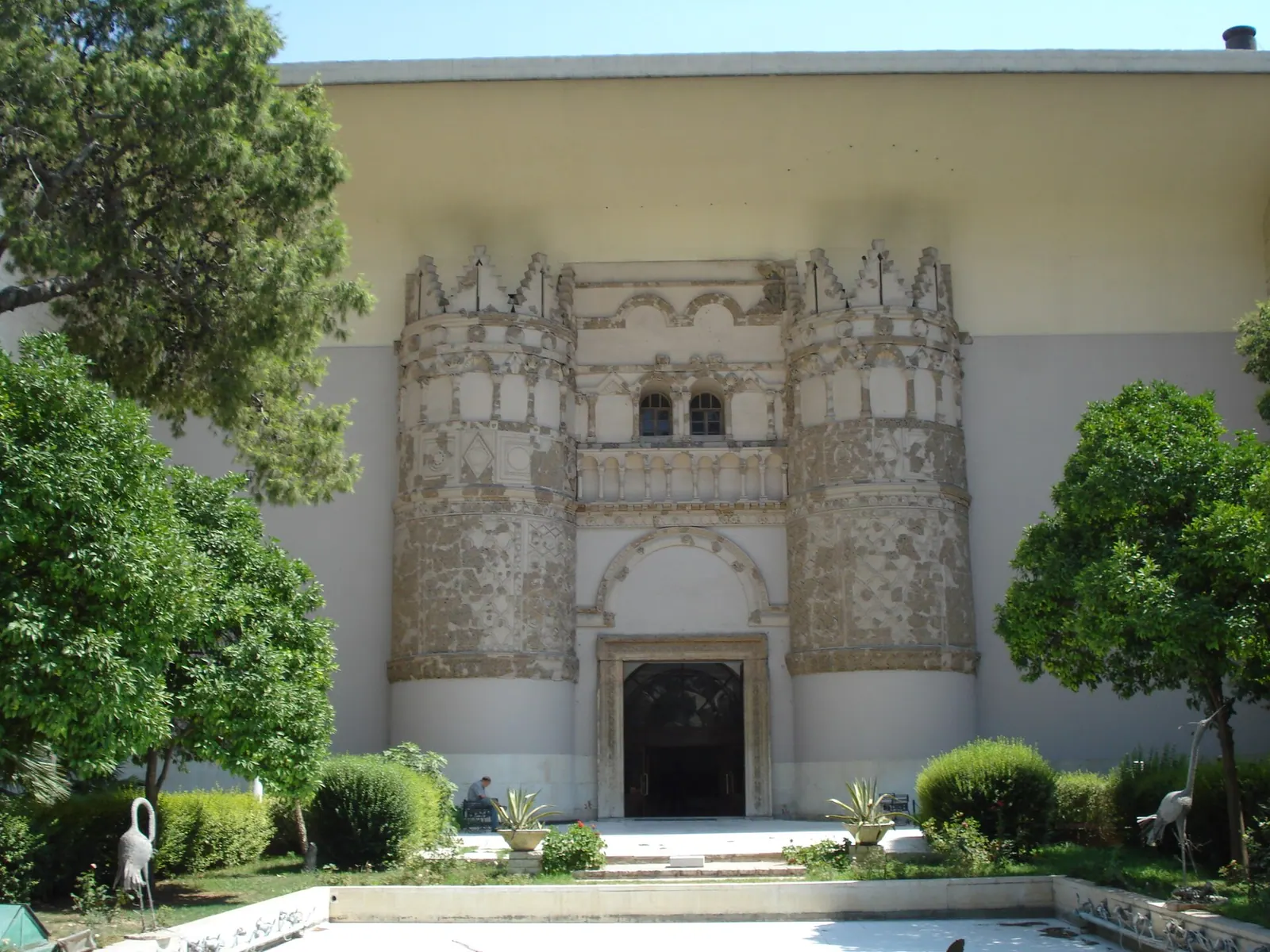
The facade of the National Museum of Damascus, which is the facade of the Qasr al-Hayr al-Gharbi palace · Photo: User:Aziz1005 · Public domain · Wikimedia Commons · Recorded 2007
National Museum of Damascus
Local name: المتحف الوطني بدمشق
The National Museum of Damascus was founded in 1919 and is Syria's national and largest museum. It covers finds from prehistory to the Islamic period, including material from Ugarit, Mari and Ebla, as well as contemporary art. Among its best-known exhibits are the wall paintings of the Dura-Europos synagogue.
History
The museum was established in 1919, during King Faisal's short-lived Arab Kingdom of Syria, and was first housed in the al-Adiliyya Madrasa. According to the Arabic Wikipedia, donations from Damascene families formed the core of the collection in 1920. The present building next to the Sulaymaniyya Takiyya dates from 1936; the Arabic Wikipedia says its first section opened that year to a design by the French architect Écochard. The German Wikipedia gives 1939 for the transfer of the collections, the English Wikipedia 1950 for the official opening.
According to the English and Arabic Wikipedia, extensions followed in 1953 (a three-storey wing for Islamic-period exhibits and contemporary art), 1963 (a lecture hall furnished as an Ottoman-era Damascene reception hall, and a library), 1974 (Palaeolithic finds) and 2004 (Neolithic antiquities); the German Wikipedia mentions extensions in 1956 and 1975.
The museum closed in 2012 because of the Syrian civil war; more than 300,000 artefacts were hidden in secret locations. Four of its five wings reopened on 29 October 2018. After the fall of Damascus it closed again on 7 December 2024 and, at the request of the antiquities directorate, was secured by Hayat Tahrir al-Sham fighters; it reopened on 8 January 2025.[1][2][3]
Architecture
The long, L-shaped building stands in a garden west of the old city, between Damascus University and the Takiyya on Shukri al-Quwatli Street. Its main entrance is formed by the façade of the Umayyad desert palace of Qasr al-Hayr al-Gharbi, which was removed from the Syrian Desert and rebuilt here; the English and Arabic Wikipedia date the palace to 727. Inside, an 18th-century Damascene reception room and the Hypogeum of Yarhai from Palmyra have been reconstructed; the museum garden serves as an open-air display.[1][2][3]
Collection and significance
The holdings are organised in five wings: prehistory, ancient Syria, the classical age (Seleucid, Roman, Byzantine), the Islamic age and contemporary art. The museum holds more than 5,000 cuneiform tablets, among them a tablet with the Ugaritic alphabet, regarded as the earliest known alphabet, as well as sculptures from Tell Halaf.
The wall paintings of the Dura-Europos synagogue were moved to Damascus in the 1930s; the assembly hall is displayed in the museum in its original arrangement. According to the German Wikipedia, viewing time is limited for conservation reasons. In 2025 a delegation of scholars from outside Syria was able to see the paintings for the first time in decades.[1][2][4]
Timeline
- 1919
Museum founded, first housed in the al-Adiliyya Madrasa.[1][2][3]
- 1936
Present building erected next to the Takiyya (Arabic Wikipedia: first section opened).[1][2][3]
- 1950
Official opening after installation of the Qasr al-Hayr al-Gharbi façade (per English Wikipedia).[1]
- 2012
Closure because of the civil war; more than 300,000 artefacts hidden.[1]
- 29 Oct 2018
Four of five wings reopen.[1]
- 2024–2025
Closed on 7 December 2024, reopened on 8 January 2025.[1]
- November 2025
Theft of six Roman-era marble statues from the classical department.[1][3]
Gallery
Documented condition
Current condition not documented · as of 2026
On 9 November 2025 (Arabic Wikipedia: the night to 10 November) six Roman-era marble statues were stolen after a break-in at the classical department. According to the Arabic Wikipedia the statues were later recovered and the thieves arrested. In July 2026 France returned 23 Syrian objects, which the museum displayed in summer 2026. No information on the condition of the building is available.[1][3]
Visiting
Getting here
Documented ride, stay and transport services in Damascus:
Nearby medical services
Straight-line distance from this place. Data: OpenStreetMap, as of 2026-10-30. Operating status not verified – call before going.
- Dermatology and Veneral Diseases HospitalHospital · 0.1 kmDirections
- Obstetrics & Gynaecology HospitalHospital · 0.2 kmDirections
- مشفى التوفيقHospital · 0.3 kmDirections
- مشفى الشرقHospital · 0.9 kmDirections
- birth hospitalHospital · 0.9 kmDirections
- Badee HospitalHospital · 0.9 kmDirections
Sources (16)
- Wikipedia (en): National Museum of Damascus rev. 1382051165 · CC BY-SA 4.0 · 2026-10-30
- Wikipedia (de): Nationalmuseum Damaskus rev. 252252659 · CC BY-SA 4.0 · 2026-10-30
- Wikipedia (ar): المتحف الوطني بدمشق rev. 74072919 · CC BY-SA 4.0 · 2026-10-30
- Wikipedia (en): Dura-Europos synagogue rev. 1370881944 · CC BY-SA 4.0 · 2026-10-30
- Wikidata · CC0 · 2026-10-30
- Wikipedia (es) · CC BY-SA 4.0 · 2026-10-30
- Wikipedia (fa) · CC BY-SA 4.0 · 2026-10-30
- Wikipedia (fr) · CC BY-SA 4.0 · 2026-10-30
- Wikipedia (id) · CC BY-SA 4.0 · 2026-10-30
- Wikipedia (it) · CC BY-SA 4.0 · 2026-10-30
- Wikipedia (nl) · CC BY-SA 4.0 · 2026-10-30
- Wikipedia (pl) · CC BY-SA 4.0 · 2026-10-30
- Wikipedia (pt) · CC BY-SA 4.0 · 2026-10-30
- Wikipedia (ru) · CC BY-SA 4.0 · 2026-10-30
- Wikipedia (zh) · CC BY-SA 4.0 · 2026-10-30
- OpenStreetMap · ODbL · 2026-10-30
Synagogen-Bezug: Verbleib der Malereien/des Versammlungsraums in diesem Museum belegt durch en-Museumsartikel, de-Museumsartikel und en-Synagogenartikel (Quelle 4); Relation holds → Q1577089. Widersprüche: (1) Gebäude – en: 1936 gebaut, offizielle Eröffnung 1950; ar: erster Abschnitt 1936 eröffnet (Architekt Écochard, nur ar); de: Umzug 1939; Erweiterungen en/ar 1953, 1963, 1974, 2004 vs. de 1956, 1975. (2) Gründung 1919 (en, de, Wikidata) vs. Sammlungsgrundstock 1920 (ar). (3) Datierung der Synagogenmalereien: en-Museumsartikel 245, ar um 246, Synagogenartikel Bauinschrift 244 – im Text nur 1930er-Überführung genannt. (4) Hypogäum des Yarhai: en datiert 108 n. Chr. und zugleich 3. Jh., de 2. Jh. – im Text nicht datiert. (5) Diebstahl: en 9.11.2025, ar Nacht zum Montag 10.11.2025; Rückgabe/Festnahme nur ar. (6) Lage Qasr al-Hair al-Gharbi: en 80 km südlich, ar 80 km südwestlich von Palmyra – nicht übernommen. Wikidata-Label en lautet 'National Museum in Damascus', Titel der en-Wikipedia 'National Museum of Damascus'. Label der Relation Q3766 nach P131 und Artikeltext.