
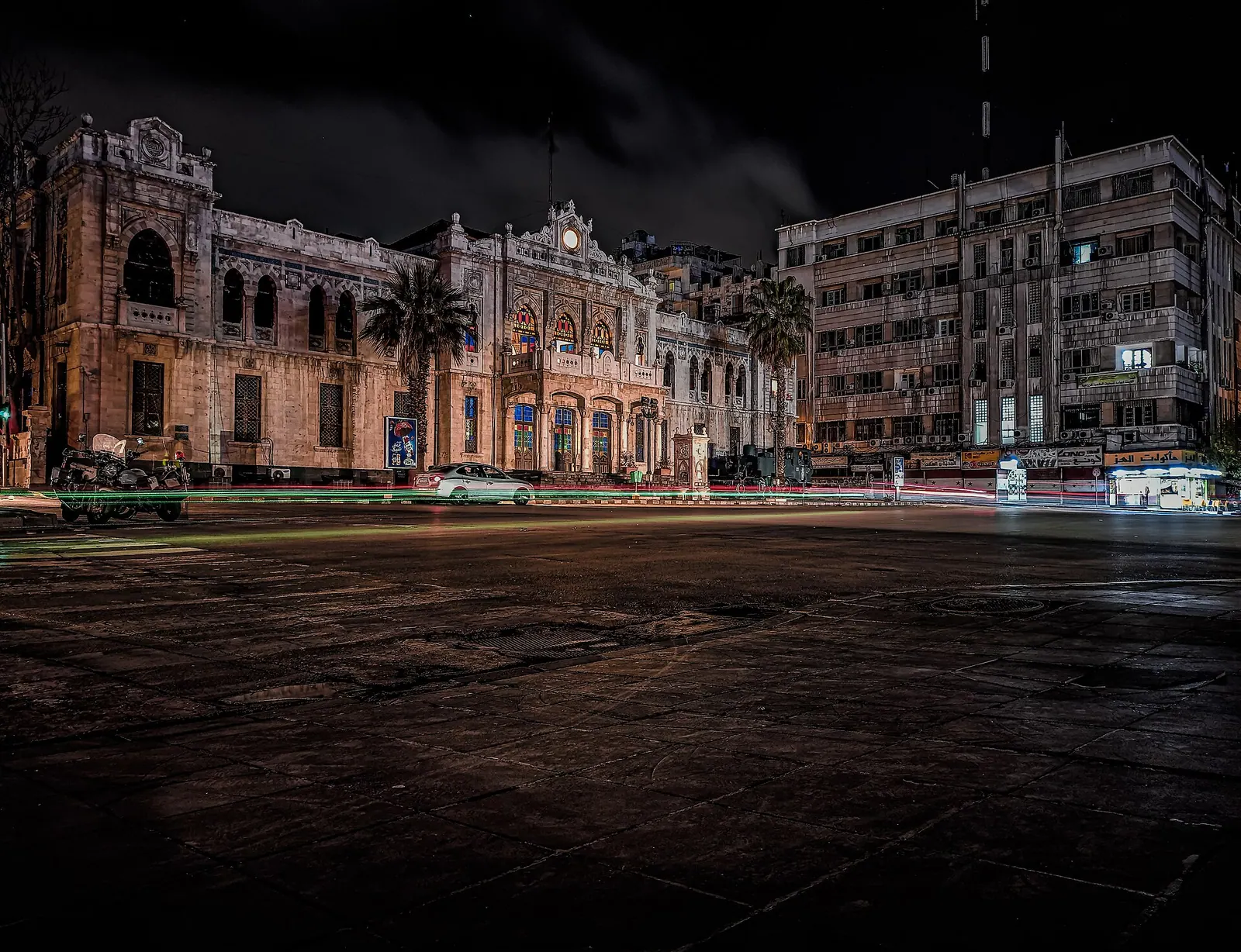
Photo: Mr85HelaL · CC BY-SA 4.0 · Wikimedia Commons · Recorded 2020
Hejaz railway station, Damascus
Local name: محطة الحجاز
The Hejaz railway station (Mahattat al-Hijaz) is a former main railway station in central Damascus, close to Marjeh Square. It was the starting point of the Hejaz railway to Medina; its passenger building, commissioned in 1913 to a design by the Spanish architect Fernando de Aranda, later became a historical monument.
History
According to the Arabic Wikipedia, the idea of a railway from Damascus to the Hejaz first arose in 1864: Damascus was the assembly point of the pilgrim caravan, which took about 40 days on the old caravan route to reach the holy places. The same source credits the realisation of the project to the governor Hussein Nazim Pasha and the Damascene statesman Ahmad Izzat Pasha al-Abid.
The English Wikipedia states that the station was put into operation under the Ottoman Empire in 1907 and that from 1909 trains ran frequently between Damascus and Medina. The passenger building designed by Fernando de Aranda was commissioned in 1913. According to the Arabic Wikipedia, service on the line to the Hejaz has been suspended since 1917.[1][2]
Architecture
The passenger building has a decorated interior ceiling. A Swiss-made locomotive is displayed in front of it.[1]
Use and significance
The railway carried pilgrims, merchants, passengers and goods from Damascus to the Arabian Peninsula. In the 20th century trains left the station in several directions, among them, according to the Arabic Wikipedia, the well-remembered “summer resorts train” through the Barada valley via Rabweh, Dummar, Ain al-Fijeh and Madaya to Zabadani and Serghaya.[2]
Timeline
Gallery
Documented condition
Current condition not documented · as of 2026
According to the English Wikipedia the actual platforms of the station are closed, and the building has become a historical monument. The source gives no date for these statements.[1]
Visiting
Getting here
Documented ride, stay and transport services in Damascus:
Nearby medical services
Straight-line distance from this place. Data: OpenStreetMap, as of 2026-10-30. Operating status not verified – call before going.
- Dermatology and Veneral Diseases HospitalHospital · 0.4 kmDirections
- Obstetrics & Gynaecology HospitalHospital · 0.5 kmDirections
- Al kendy HospitalHospital · 0.6 kmCallDirections
- مشفى التوفيقHospital · 0.7 kmDirections
- مشفى الشرقHospital · 0.9 kmDirections
- birth hospitalHospital · 0.9 kmDirections
Sources (7)
- Wikipedia (en): Hejaz railway station, Damascus rev. 1375196455 · CC BY-SA 4.0 · 2026-10-30
- Wikipedia (ar): محطة الحجاز rev. 72929732 · CC BY-SA 4.0 · 2026-10-30
- Wikidata · CC0 · 2026-10-30
- Wikipedia (fa) · CC BY-SA 4.0 · 2026-10-30
- Wikipedia (fr) · CC BY-SA 4.0 · 2026-10-30
- Wikipedia (ja) · CC BY-SA 4.0 · 2026-10-30
- Wikipedia (tr) · CC BY-SA 4.0 · 2026-10-30
Lücken: keine deutschsprachige Wikipedia im Paket; deutscher Name nach Wikidata-Label. Nur zwei Quellen, daher kurzer Text. Widersprüche/Unklarheiten: (1) en: Inbetriebnahme 1907 'als der erste Abschnitt der Strecke südlich von Tabuk eröffnet wurde' – geographisch unklar, nur das Jahr übernommen. (2) ar: Verwirklichung 'bis Ende des 18. Jahrhunderts verzögert' – offensichtlich fehlerhaft, nicht übernommen. (3) ar: Kosten 5000 osmanische Goldlira für das Gesamtprojekt – unplausibel und unbelegt, nicht übernommen. (4) Verhältnis Inbetriebnahme 1907 zu Auftrag des Empfangsgebäudes 1913 (Wikidata-Inception 1913) wird in den Quellen nicht erläutert. Kein UNESCO-Bezug. Wikidata P84 (Architekt) = Q5860430, Name nach en-Wikipedia. Aktuelle Nutzung des Gebäudes nicht dokumentiert.