
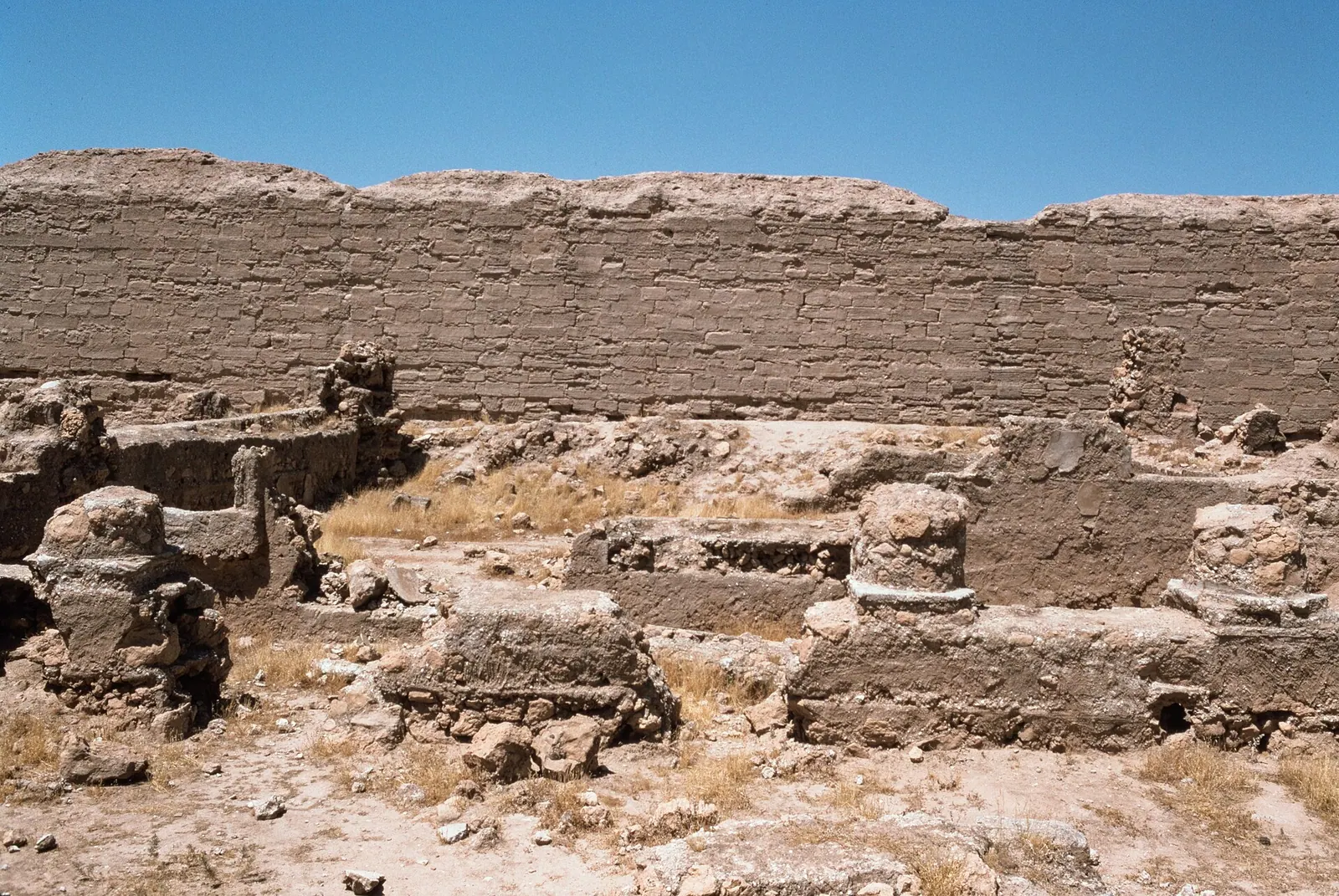
Photo: Frank Kidner · CC BY-SA 4.0 · Wikimedia Commons · Recorded 1993
Dura-Europos synagogue
Local name: كنيس دورا أوروبوس
The Dura-Europos synagogue was a Jewish house of worship in the ancient city of Dura-Europos on the Euphrates, in today's Deir ez-Zor Governorate. It is a single building within that city, built against the western city wall; its last building phase is dated by an Aramaic inscription to 244. According to the sources, its painted assembly hall, uncovered in 1932, is now preserved in the National Museum of Damascus.
History
The city of Dura-Europos was founded around 300 BC by Seleucus I as a fortress on the route between Antioch and Seleucia on the Tigris. The Parthians took it in 113 BC; from 165 AD it was a Roman frontier stronghold until the Sasanian king Shapur I captured it after a siege in 256, or 256–257. Its population was deported and the city was never permanently resettled.
The synagogue developed from a private house in block L7. The German Wikipedia states that it was probably used for worship from the late second century, while the chronology after Clark Hopkins in the English article on the city dates the conversion to c. 165–200. The building was remodelled in 244/245, as an Aramaic inscription and inscribed ceiling tiles show; one Greek tile names Samuel son of Yedaya, elder of the Jews, as founder in 245.
Before the Sasanian assault the Roman garrison filled the buildings along the western wall with earth and rubble to reinforce it, burying most of the synagogue. A Yale and French team led by Clark Hopkins uncovered it in 1932. Moving the entire building to Yale was not permitted, and the paintings went to Damascus.[1][2][3][4][5]
Architecture
The house measured about 15 by 8 m, with an annex of about 10 by 8 m; rooms were grouped around a courtyard, and the annex contained a peristyle forecourt and the assembly hall. The hall measured 13.65 by 7.68 m with a ceiling about 7 m high; its western wall, facing Jerusalem, held the Torah shrine. The ceiling was lined with painted terracotta tiles, 234 of which were recovered, showing flowers, fruit, animals, female faces and zodiac signs, or Greek and Aramaic inscriptions.
The paintings run in three registers above a dado, reaching about 7 m. Technically they are tempera on plaster rather than true fresco. Because of the slope of the fill, the west wall survived almost entire, the north and south walls about halfway, and the east wall only as a narrow strip.[1][2]
Use and significance
The building served the Jewish community of a multilingual garrison town and through successive enlargements became the core of a small Jewish quarter. Inscriptions and graffiti from the synagogue are in Aramaic, Greek, Middle Persian and Parthian; most of the Persian ones were written on the paintings and record the appreciation of visitors from elsewhere. Its use ended with the burial of 256.
Today, according to the English Wikipedia, the painted hall is installed in the National Museum of Damascus in its original arrangement; the German Wikipedia speaks of a dedicated room. In 2025, after the fall of the Assad government, a delegation of scholars from abroad was able to see the paintings for the first time in decades.[1][2][3]
Notable features
The 58 surviving scenes, probably about 60% of the original programme, draw on the Hebrew Bible: the binding of Isaac, Moses at the burning bush and leading the Israelites through the Red Sea, Ezekiel's vision, Mordecai and Esther, Samuel anointing David. The Hand of God marks divine intervention; the Israelites appear as an armed force with Roman-style shields and standards, the Tabernacle as a Roman temple and Aaron in Persian dress. The find challenged narrow readings of a Jewish prohibition of images. The UNESCO Tentative List entry, on which Dura-Europos has stood since 1999, counts the synagogue paintings among the city's most famous.[1][2][3][5]
Timeline
- c. 300 BC
- c. 165–200
- 244/245
Last building phase, dated by an Aramaic inscription and ceiling tiles.[1][2]
- c. 244–254
The wall paintings are executed (chronology after Hopkins).[3]
- 256–257
Buried when the city wall is reinforced; the Sasanians capture the city.[1][2][3]
- 1932
Uncovered by the Yale-French team under Clark Hopkins.[1][2][3]
- possibly 2014
The remains of the synagogue on site apparently destroyed.[1]
- 2025
For the first time in decades a delegation of scholars from abroad sees the paintings in Damascus.[1]
Gallery
Documented condition
Destroyed · as of 2014
City level: Dura-Europos was looted and largely destroyed between 2011 and 2014 under IS; satellite imagery from 2015 showed more than 70% of the site devastated by looters. Building level: according to the English Wikipedia, what remained of the synagogue on site appears to have been destroyed, possibly in 2014. The paintings and the reassembled hall are in the National Museum of Damascus; their present state of preservation is not described in the sources.[1][3][4]
Visiting
Getting here
Documented ride, stay and transport services in Deir ez-Zor:
Nearby medical services
Straight-line distance from this place. Data: OpenStreetMap, as of 2026-10-30. Operating status not verified – call before going.
- مشفى هجين العامHospital · 11 kmDirections
- Subaykhan HospitalClinic / health centre · 16 kmDirections
Sources (16)
- Wikipedia (en): Dura-Europos synagogue rev. 1370881944 · CC BY-SA 4.0 · 2026-10-30
- Wikipedia (de): Synagoge von Dura Europos rev. 252572566 · CC BY-SA 4.0 · 2026-10-30
- Wikipedia (en): Dura-Europos rev. 1381351642 · CC BY-SA 4.0 · 2026-10-30
- Wikipedia (de): Dura Europos rev. 266959850 · CC BY-SA 4.0 · 2026-10-30
- UNESCO World Heritage Centre, Tentative List: Dura Europos · 2026-10-30
- Wikidata · CC0 · 2026-10-30
- Wikipedia (es) · CC BY-SA 4.0 · 2026-10-30
- Wikipedia (fa) · CC BY-SA 4.0 · 2026-10-30
- Wikipedia (fr) · CC BY-SA 4.0 · 2026-10-30
- Wikipedia (id) · CC BY-SA 4.0 · 2026-10-30
- Wikipedia (it) · CC BY-SA 4.0 · 2026-10-30
- Wikipedia (nl) · CC BY-SA 4.0 · 2026-10-30
- Wikipedia (pl) · CC BY-SA 4.0 · 2026-10-30
- Wikipedia (pt) · CC BY-SA 4.0 · 2026-10-30
- Wikipedia (ru) · CC BY-SA 4.0 · 2026-10-30
- OpenStreetMap · ODbL · 2026-10-30
Ebenen: Die Synagoge (Q1577089) ist ein Gebäude in der antiken Stadt Dura Europos (Q464266); kein eigener UNESCO-Status (Wikidata unesco null), die Stadt steht seit 1999 auf der Tentativliste (Eintrag 1295; laut en-Wikipedia 2011 erneut zusammen mit Mari). Verbleib der Malereien laut en- und de-Wikipedia: Nationalmuseum Damaskus (en: Versammlungsraum in ursprünglicher Anordnung; de: eigener Raum) – keine weitere Angabe übernommen. Widersprüche/Unsicherheiten: (1) Lage an der Westmauer – en-Synagogenartikel: Block L7 an der Mauerstraße zwischen Turm 19 und 20; en-Stadtartikel: zwischen Turm 18 und 19. (2) Umbau zur Synagoge – de: wohl spätes 2. Jh.; Hopkins-Chronologie (en-Stadtartikel): um 165–200; Wikidata-Inception 150. (3) Fall der Stadt 256 (de-Synagoge, ar-Stadt) bzw. 256–257 (en) bzw. um 256/7 (de-Stadt). (4) en-Einleitung nennt den Bau „virtually intact“, zugleich sind nur ca. 60 % der Szenen erhalten; im Text die differenzierte Angabe nach de (Westwand fast vollständig, Nord/Süd etwa zur Hälfte). (5) Die Malereien werden in den Quellen teils „Fresken“ genannt, technisch laut en Tempera auf Putz. (6) Zerstörung der Reste am Ort nur als „appear to have been destroyed, possibly in 2014“ belegt; Wikidata führt den Status „destroyed“ ohne Datum.