
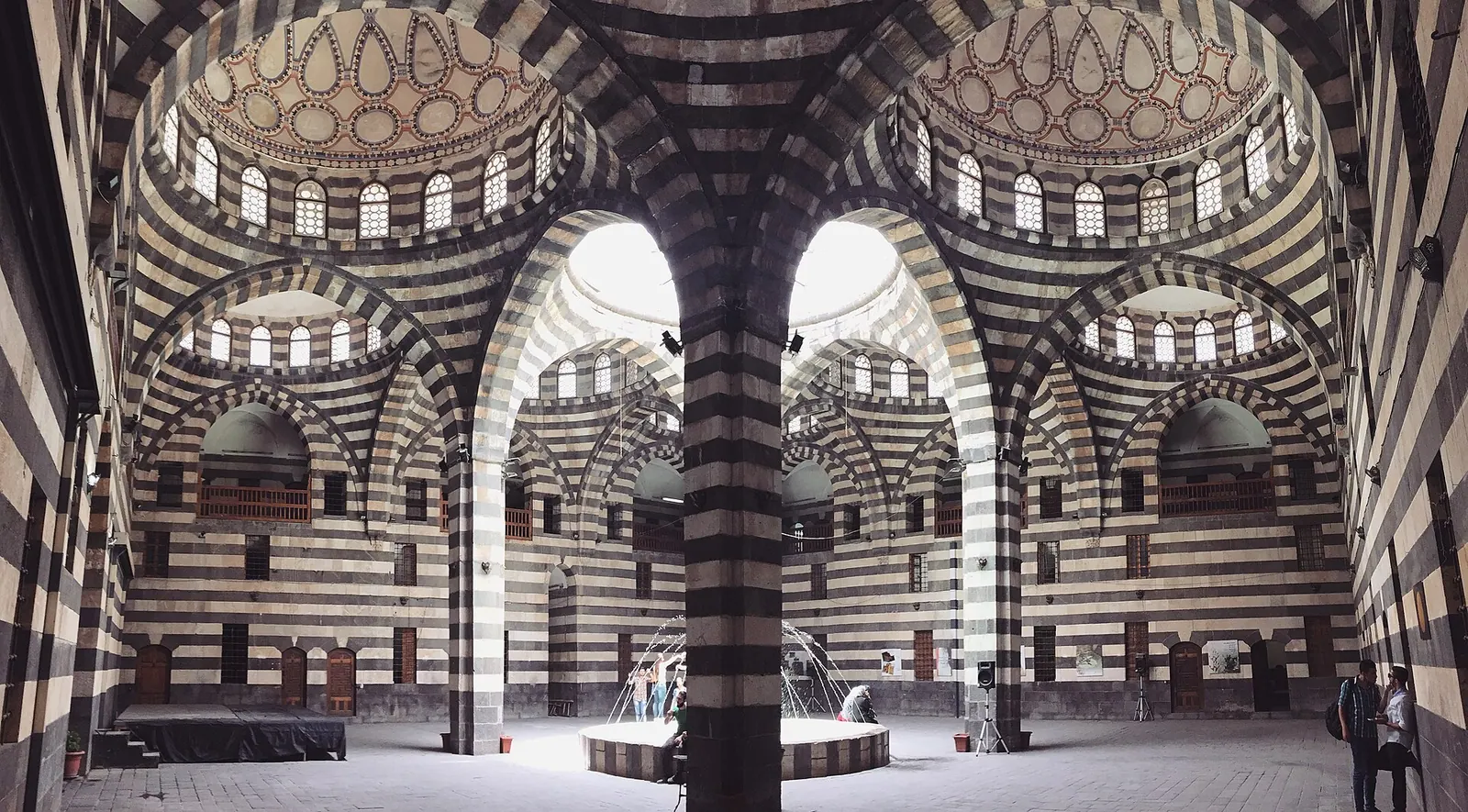
This is a photo of a monument in Syria identified by the ID · Photo: Bassel Khabbaz · CC BY-SA 4.0 · Wikimedia Commons · Recorded 2016
Khan As'ad Pasha
Local name: خان أسعد باشا
Khan As'ad Pasha, covering about 2,500 m², is the largest caravanserai (khan) in the Old City of Damascus. It stands on Al-Buzuriyah Souq near the Umayyad Mosque and was built in the mid-18th century by the governor As'ad Pasha al-Azm, who also built the nearby Al-Azm Palace. It has been described as one of the finest khans of Damascus.
History
The English Wikipedia dates the construction to 1751–52, Wikidata to 1752, and the Arabic Wikipedia to 1167 AH/1753, four years after the Azm Palace; the German gives only the 18th century. The patron was As'ad Pasha al-Azm, Ottoman governor of Damascus. In the Ottoman era the khan hosted caravans from Baghdad, Mosul, Aleppo, Beirut and elsewhere, and rooms were rented to notable merchants.
According to the Arabic Wikipedia the khan was first the governor's private property, later passed to several merchants and was eventually acquired and restored by the Syrian antiquities directorate. The restoration received the Aga Khan Award for Architecture; the sources give no year.[1][2][3]
Architecture
The building uses Damascene black-and-white masonry with alternating light and dark courses. The wide façade has a large decorated portal with a muqarnas niche at its centre. The courtyard is divided into nine equal squares; eight carry domes, each on four massive piers, while the central one is a circular opening to the sky above an octagonal basin with a fountain. The English Wikipedia sees Persian echoes in the central opening. According to the Arabic Wikipedia, a glass dome designed by the architect Abir Arqawi was later added over the opening, and the domes rise to 20 m.
The ground floor served for storage and stabling; the Arabic Wikipedia counts 21 storerooms and a small mosque in the north-west corner. On the upper floor, behind galleries, are 45 guest rooms with small domes and original doors and windows. The domed roof protected the goods from light, heat and cold.[1][2][3]
Use and significance
According to the German Wikipedia the khan serves as a museum and cultural centre for exhibitions and concerts; the Arabic describes it as a venue for exhibitions and a crafts market. The English Wikipedia calls it the most "ambitious" work of architecture in the city. The Ancient City of Damascus is a UNESCO World Heritage Site, and UNESCO explicitly names khans among the buildings that underpin its value.[1][2][3][4]
Timeline
Gallery
3D documentation
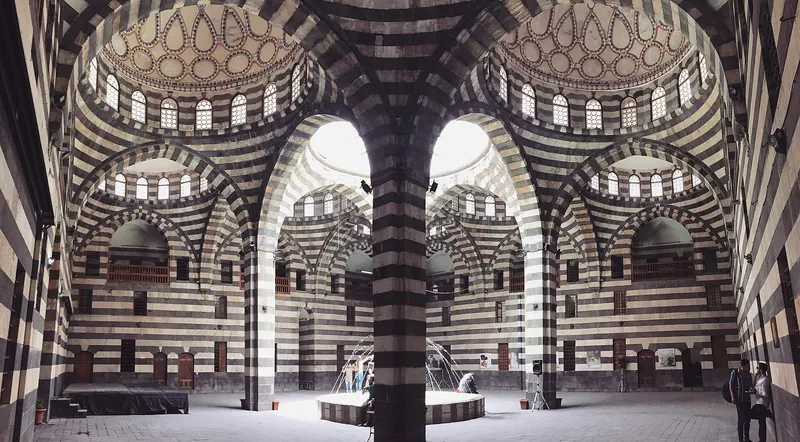
Loaded from Sketchfab only after you click. Data is then sent to Sketchfab.
The 3D player could not be loaded here.
View 3D model on SketchfabLoading …
Khan As'ad Pasha
3D: Fovea (3dfovea) · Captured 2019 · Licence: CC BY-NC-SA 4.0 · DOI · Open on Sketchfab
Drag to rotate, scroll or pinch to zoom, full screen in the player.
Documented condition
Current condition not documented
The sources contain no dated condition statement. They document the restoration and the use as a cultural and exhibition venue; according to the Arabic Wikipedia some domes were restored "recently". The Ancient City of Damascus has been on the List of World Heritage in Danger since 2013.[2][3][4]
Visiting
Getting here
Documented ride, stay and transport services in Damascus:
Nearby medical services
Straight-line distance from this place. Data: OpenStreetMap, as of 2026-10-30. Operating status not verified – call before going.
- مركز الإغاثة والتنمي أر دي سيHospital · 1 kmDirections
- Al kendy HospitalHospital · 1.1 kmCallDirections
- مستشفى الرشيد التخصصيHospital · 1.1 kmCallDirections
- Al Rasheed HospitalHospital · 1.1 kmDirections
- مشفى الغزاليHospital · 1.1 kmDirections
- HospitalHospital · 1.2 kmDirections
Sources (12)
- Wikipedia (en): Khan As'ad Pasha rev. 1378013828 · CC BY-SA 4.0 · 2026-10-30
- Wikipedia (de): Chan As'ad Pascha rev. 228964062 · CC BY-SA 4.0 · 2026-10-30
- Wikipedia (ar): خان أسعد باشا rev. 76936020 · CC BY-SA 4.0 · 2026-10-30
- UNESCO World Heritage Centre: Ancient City of Damascus · 2026-10-30
- Wikidata · CC0 · 2026-10-30
- Wikipedia (es) · CC BY-SA 4.0 · 2026-10-30
- Wikipedia (fa) · CC BY-SA 4.0 · 2026-10-30
- Wikipedia (fr) · CC BY-SA 4.0 · 2026-10-30
- Wikipedia (it) · CC BY-SA 4.0 · 2026-10-30
- Wikipedia (tr) · CC BY-SA 4.0 · 2026-10-30
- Wikipedia (ur) · CC BY-SA 4.0 · 2026-10-30
- OpenStreetMap · ODbL · 2026-10-30
Baujahr 1751–52 (en) vs. 1752 (Wikidata P571) vs. 1167 H./1753 (ar) vs. „18. Jh.“ (de). Die de-Wikipedia nennt den Bauherrn „Azim Pascha“; gemeint ist As'ad Pascha al-Azm. Die en-Deutung der acht Kuppeln als Anspielung auf schiitische Tradition wurde als unbelegte Einzelwertung nicht übernommen. Jahr des Aga-Khan-Preises und Datum der Restaurierung fehlen. Die UNESCO-Seite nennt den Chan nicht namentlich, nur „khans“ allgemein; die Lage in der Altstadt ist durch en/de/ar belegt. Nutzungsangaben (Museum/Kulturzentrum/Handwerksmarkt) undatiert; kein aktueller Zustand. Zeitleiste nur mit zwei Einträgen, da die Quellen keine weiteren Daten nennen.