
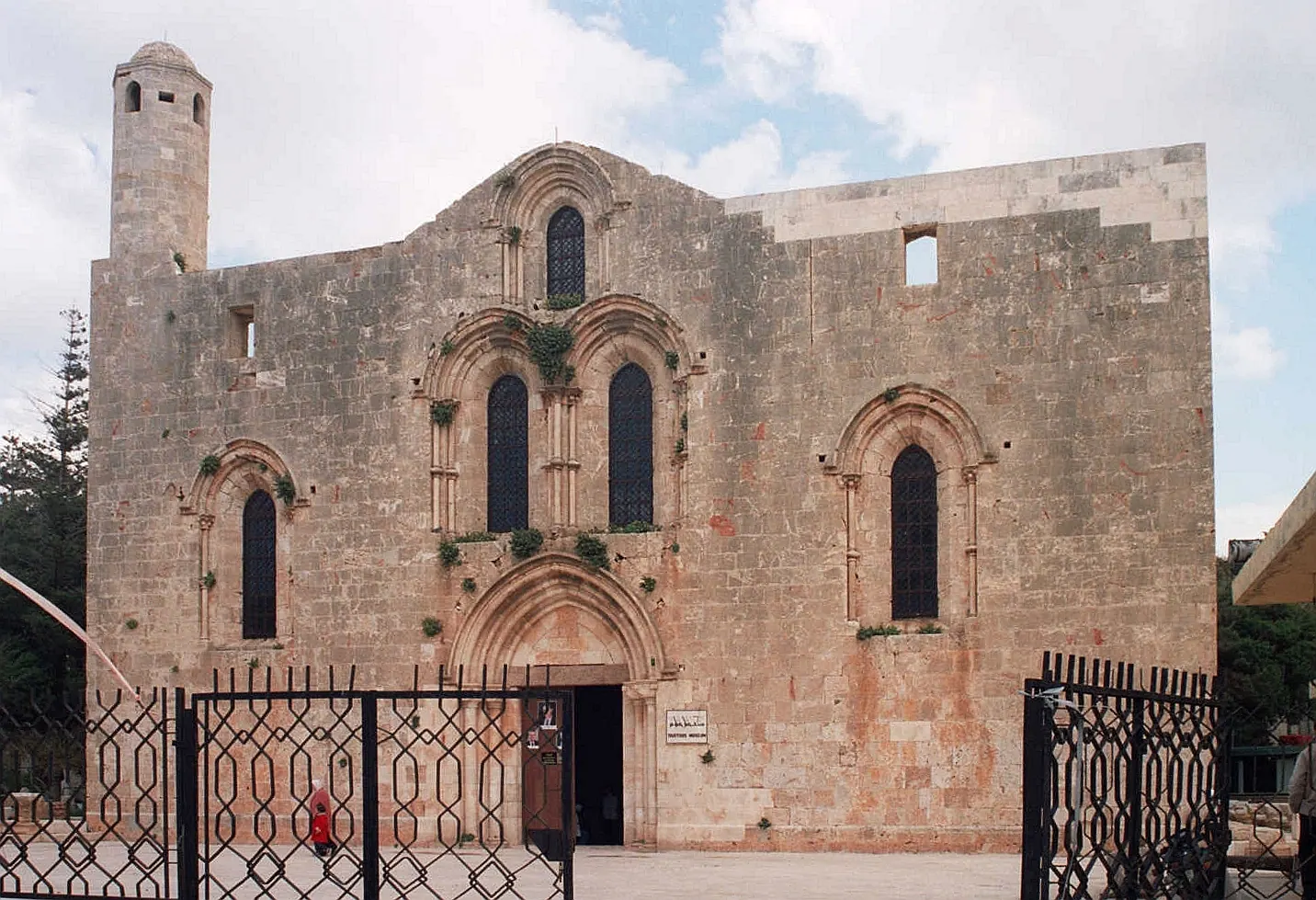
Photo: author unknown · CC BY-SA 3.0 · Wikimedia Commons
Cathedral of Our Lady of Tortosa
Local name: كاتدرائية طرطوس
The Cathedral of Our Lady of Tortosa is the former Crusader cathedral of Tartus, built in the 12th and 13th centuries on the site of a Byzantine Marian shrine. Historians have called it the best-preserved religious structure of the Crusades. After 1291 it became a mosque; since 1956 it has housed the National Museum of Tartus.
History
Since Byzantine rule the site was believed to be that of a church to the Virgin Mary founded by Saint Peter, and it drew Christian pilgrims. According to UNESCO's description, tradition held that an icon said to have been painted by Saint Luke was kept there, the one the convent of Saydnaya now claims to hold.
Frankish forces captured Tortosa in 1099 during the First Crusade, and the cathedral was built over the Byzantine church. The German Wikipedia places the start of construction in the second quarter of the 12th century, UNESCO's description gives 1123. The Knights Templar governed the town from 1152 to 1291 and, according to the German Wikipedia, completed the building around the mid-13th century. An earthquake damaged it in 1202, and it was soon repaired. In 1213 Raymond, son of Bohemond IV of Antioch, was killed in the cathedral by the Assassins. From the 1260s the church was fortified against the Mamluk threat.
The Templars abandoned Tortosa, one of the last Frankish cities in the region, in 1291. Under the Mamluks the cathedral was turned into a mosque, as the minaret on the west façade still shows. In the Ottoman period, according to the German Wikipedia, it served as a stable.[1][2][3][4]
Architecture
The church follows a basilica plan with three aisles and three apses. The eastern end, built first, is Romanesque; the 13th-century western end is Early Gothic. The English Wikipedia gives a length of over 45 metres and a width of 30 metres, UNESCO's description 41 by 34.5 metres. The nave has a pointed barrel vault; the shrine of the Virgin is on the north side of the nave. Buttresses project from the north and south walls, while the Gothic-influenced west façade has none but carries a polygonal bell tower and single windows.
Tortosa is probably the only Latin church still standing that was fortified for defence. Sacristies in the north-east and south-east corners provided cover, and the buttresses received machicolations; according to Camille Enlart, two towers were also built over the western aisle bays. UNESCO's description dates the strengthening of the corners with towers to the end of the 13th century.[1][4]
Use and significance
Since 1956 the building has housed the National Museum of Tartus, which exhibits archaeology from the area. UNESCO's Tentative List presents Crusader Tartus, with its cathedral and keep, as an example of a city reshaped by the Crusaders, describing the cathedral as the most remarkable Frankish religious building outside Jerusalem.[1][2][4]
Timeline
- 1099
Frankish capture of Tortosa in the First Crusade.[1]
- 1123 / 2nd quarter 12th c.
Construction of the cathedral begins (UNESCO: 1123; German Wikipedia: second quarter of the 12th century).[2][4]
- 1152–1291
- 1202
Earthquake damage, soon repaired.[1]
- 1213
Raymond, son of Bohemond IV, is killed in the cathedral.[1]
- 1260s
Fortified against the Mamluks.[1]
- 1291
Templars leave; conversion into a mosque under the Mamluks.[1][2]
- 1956
The building becomes the National Museum of Tartus.[1]
Gallery
Documented condition
Current condition not documented · as of 2026
The sources contain no dated condition report. According to the English Wikipedia (as of 2026) the building serves as the National Museum of Tartus.[1]
Visiting
Getting here
Documented ride, stay and transport services in Tartus:
Nearby medical services
Straight-line distance from this place. Data: OpenStreetMap, as of 2026-10-30. Operating status not verified – call before going.
- Al Hekma HospitalHospital · 0.6 kmDirections
- PascualHospital · 0.7 kmCallDirections
- Speciality Radiology CenterHospital · 0.8 kmDirections
- Syrian IVF CentreHospital · 0.9 kmDirections
- مستشفى التوليدHospital · 0.9 kmDirections
- Al Muna Hospital مشفى المنىHospital · 0.9 kmDirections
Sources (10)
- Wikipedia (en): Cathedral of Our Lady of Tortosa rev. 1367269120 · CC BY-SA 4.0 · 2026-10-30
- Wikipedia (de): Unsere Liebe Frau von Tortosa rev. 252234257 · CC BY-SA 4.0 · 2026-10-30
- Wikipedia (ar): كاتدرائية طرطوس rev. 74719881 · CC BY-SA 4.0 · 2026-10-30
- UNESCO World Heritage Centre: Tentative List entry 1301 (Tartus, Crusader city) · 2026-10-30
- Wikidata · CC0 · 2026-10-30
- Wikipedia (es) · CC BY-SA 4.0 · 2026-10-30
- Wikipedia (fr) · CC BY-SA 4.0 · 2026-10-30
- Wikipedia (it) · CC BY-SA 4.0 · 2026-10-30
- Wikipedia (nl) · CC BY-SA 4.0 · 2026-10-30
- OpenStreetMap · ODbL · 2026-10-30
Widersprüche: (1) Baubeginn – UNESCO 1123, de zweites Viertel 12. Jh., en 'Mitte 12. bis 13. Jh.' bzw. nach 1099. (2) Maße – en >45 × 30 m, UNESCO 41 × 34,5 m. (3) Befestigung – en 1260er; UNESCO Ecktürme Ende 13. Jh.; ar-Wikipedia schreibt fehlerhaft 'Sechzigerjahre des 19. Jh.' (Übersetzungsfehler, nicht übernommen). (4) UNESCO nennt gescheiterte mamlukische Angriffe '1276 et 1270' (Reihenfolge verdreht) – nicht übernommen. UNESCO: Tentativliste 1301 betrifft das kreuzfahrerzeitliche Tartus insgesamt (Titel des Eintrags nicht im Paket, Name der Quelle beschreibend); Jahr der Aufnahme nicht im Paket. Ar-Wikipedia ist weitgehend Übersetzung der en-Fassung und dient nur als Bestätigung (Geschichte) und für den arabischen Namen. Pferdestall in osmanischer Zeit nur de. Label der Relation Q174916 nach P131 und Artikeltext.