
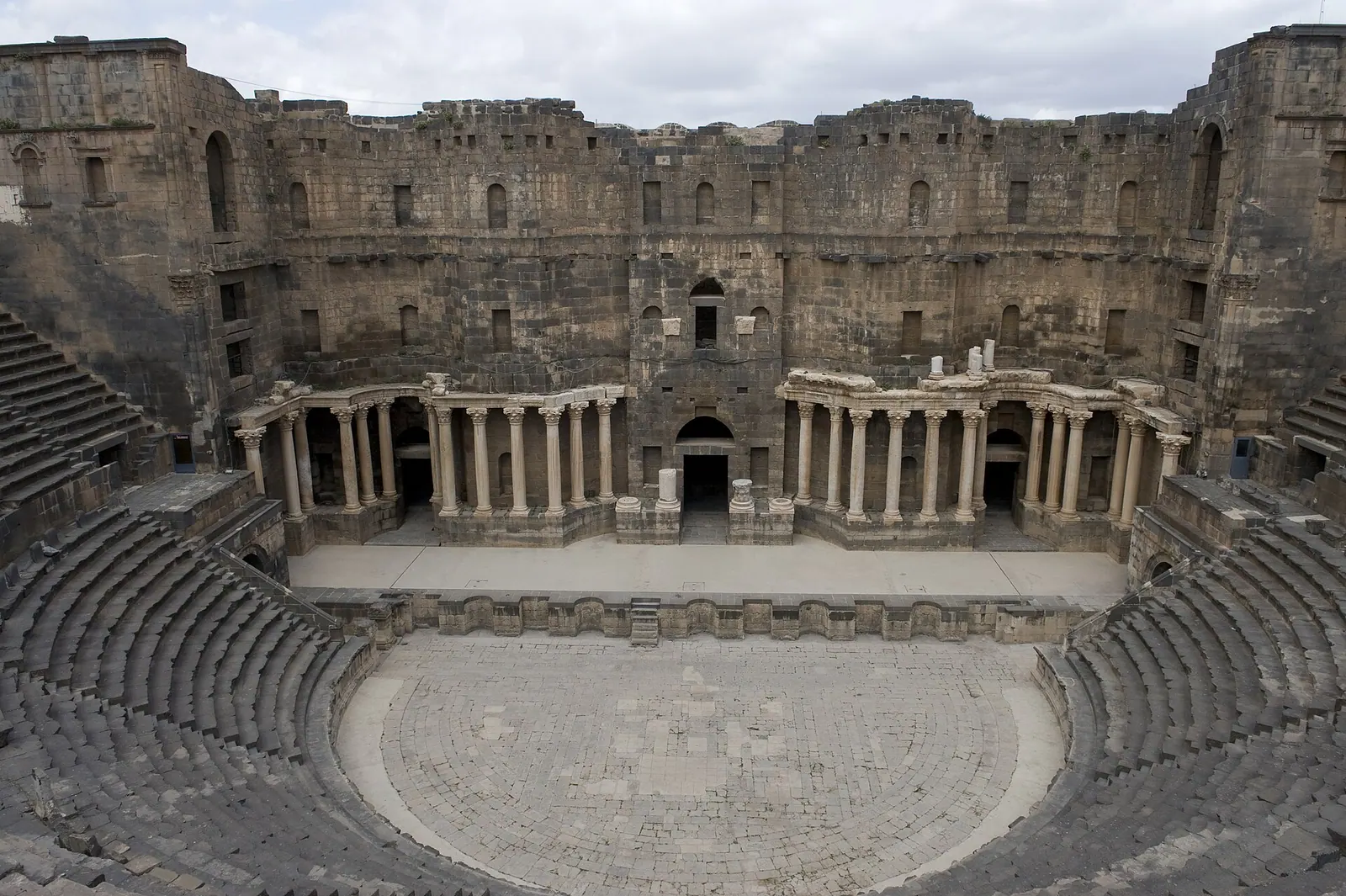
A quiet moment in the theatre · Photo: Dosseman · CC BY-SA 4.0 · Wikimedia Commons · Recorded 2009
Roman Theatre at Bosra
Local name: مسرح بصرى
The Roman Theatre at Bosra, in Daraa Governorate in southern Syria, is a second-century AD theatre built of black basalt. In the Middle Ages it was gradually enclosed by a fortress, which did much to preserve it. It is the principal monument of the World Heritage property Ancient City of Bosra, inscribed by UNESCO in 1980.
History
Bosra became part of the Roman Empire in 106 and capital of the province of Arabia. The exact construction date of the theatre is unknown. The English Wikipedia places it in the second quarter or second half of the second century and considers Trajan's reign likely, and UNESCO also names Trajan; the Arabic Wikipedia instead regards Hadrian's reign (117–138) as most probable.
The theatre originally stood outside the town walls, south of the city according to the Arabic Wikipedia, because the centre was already built up. UNESCO states that it was fortified between 481 and 1251. The Arabic article describes the stages: according to Ibn Asakir the first fortifications came in the Abbasid period, when the outer doors were blocked and the building became known as Mal'ab al-Rum; three towers were added under the Fatimids, and in the 13th century the Ayyubid al-Adil and his sons built nine towers, storerooms, a cistern and a moat.
Archaeological work began in 1930 under the French Mandate. From the late 1940s the seating, hidden by Islamic-period structures and a water tank, was uncovered, and the Syrian antiquities directorate continued the clearance until 1970. The English Wikipedia dates the substantial restoration to 1947–1970. A museum was opened inside the citadel in 1975.[1][2][4]
Architecture
The cavea, of local basalt, is 102 m across; the Arabic Wikipedia gives a height of 22 m and a stage 45.5 m long and 8.5 m deep. Thirty-seven rows of seats are divided into tiers which, according to that source, were reserved for senators, for knights and the middle class, and for the common people; vaulted passages and stairs served the three levels. Boxes for the provincial governor and distinguished guests were set into the side walls flanking the stage.
UNESCO stresses that the theatre is intact including its upper gallery. According to the Arabic Wikipedia, columns and entablature of this colonnade, combining Doric and Corinthian elements, still stand in their original position. The stage wall is articulated by niches and large doors leading to the backstage rooms.[1][2][4]
Use and significance
In the Roman period, according to the Arabic Wikipedia, the theatre probably staged Greek and Latin comedies and tragedies, and recent studies also assume religious performances with dance and music; there is no evidence for animal fights. In the Middle Ages it became part of a citadel that, as UNESCO notes, guarded the road to Damascus, reached by a wooden bridge leading to a single entrance. In more recent times the Arabic Wikipedia names the theatre, without giving dates, as a venue of the Bosra International Festival.[1][2][4]
Notable features
The sources give a capacity of about 17,000; elsewhere the Arabic Wikipedia also mentions around 10,000, or 10,000 to 15,000. The English Wikipedia counts the theatre among the largest and best preserved of the Roman world and suggests that sand filling the interior before clearance may have helped protect it. UNESCO regards the incorporation of the theatre into later fortifications as a unique architectural achievement.[1][2][4]
Timeline
- 106
Bosra becomes Roman and capital of the province of Arabia.[2][4]
- 2nd c.
Construction of the theatre (under Trajan per the English Wikipedia and UNESCO, under Hadrian per the Arabic Wikipedia).[1][2][4]
- 481–1251
- 13th c.
Expansion into an Ayyubid citadel with nine towers and a moat.[2]
- 1947–1970
- 1980
Ancient City of Bosra inscribed on the World Heritage List.[3][4]
- 2013
Placed on the List of World Heritage in Danger (per UNESCO; the articles on the Ancient City give 2017).[1][3][4]
Gallery
3D documentation
Loaded from Sketchfab only after you click. Data is then sent to Sketchfab.
The 3D player could not be loaded here.
View 3D model on SketchfabLoading …
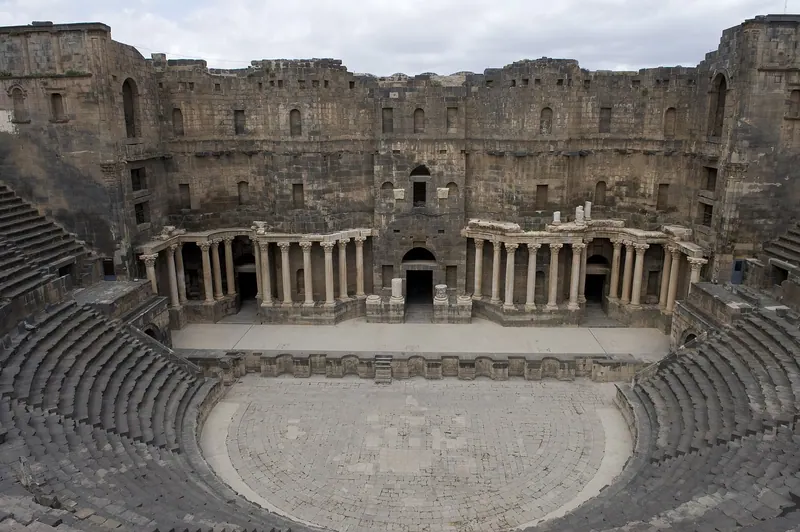
Roman Theatre at Bosra
Reconstructions show an earlier state; parts are based on assumptions.
3D: Petr Vavrečka (Project Mosul / Rekrei) · Captured 2017 · Licence: no free licence stated (embedded only) · Open on Sketchfab
Drag to rotate, scroll or pinch to zoom, full screen in the player.
Documented condition
Partly damaged · as of 2018
UNESCO has listed the Ancient City of Bosra as World Heritage in Danger since 2013; the English Wikipedia confirms this status as of July 2018. According to that source the site was damaged during the civil war by military activity nearby, including snipers operating there. The nature and extent of damage to the theatre are not described in the available sources. The UNESCO page lists a December 2015 news item on the destruction of remains in the Ancient City of Bosra, without the sources identifying the structure concerned.[1][4]
Visiting
Getting here
Documented ride, stay and transport services in Daraa:
Nearby medical services
Straight-line distance from this place. Data: OpenStreetMap, as of 2026-10-30. Operating status not verified – call before going.
- Zaid Al Sharity HospitalHospital · 22 kmDirections
- Blood BankHospital · 22 kmDirections
- Al 'Enaia Al-Khassa HospitalHospital · 23 kmDirections
- National Hospital of SalkhadHospital · 23 kmDirections
- Al mazraa hospitalHospital · 23 kmDirections
- Al Mazra'a HospitalHospital · 23 kmDirections
Sources (15)
- Wikipedia (en): Roman Theatre at Bosra rev. 1374911270 · CC BY-SA 4.0 · 2026-10-30
- Wikipedia (ar): مسرح بصرى rev. 72688431 · CC BY-SA 4.0 · 2026-10-30
- Wikipedia (en): Ancient City of Bosra rev. 1365730059 · CC BY-SA 4.0 · 2026-10-30
- UNESCO World Heritage Centre: Ancient City of Bosra · 2026-10-30
- Wikidata · CC0 · 2026-10-30
- Wikipedia (es) · CC BY-SA 4.0 · 2026-10-30
- Wikipedia (fr) · CC BY-SA 4.0 · 2026-10-30
- Wikipedia (hi) · CC BY-SA 4.0 · 2026-10-30
- Wikipedia (id) · CC BY-SA 4.0 · 2026-10-30
- Wikipedia (it) · CC BY-SA 4.0 · 2026-10-30
- Wikipedia (ja) · CC BY-SA 4.0 · 2026-10-30
- Wikipedia (ko) · CC BY-SA 4.0 · 2026-10-30
- Wikipedia (pl) · CC BY-SA 4.0 · 2026-10-30
- Wikipedia (ru) · CC BY-SA 4.0 · 2026-10-30
- Wikipedia (ur) · CC BY-SA 4.0 · 2026-10-30
Kein deutschsprachiger Wikipedia-Artikel im Quellenpaket; deutscher Text beruht auf en/ar-Wikipedia und UNESCO 22. Widersprüche: (1) Bauzeit – Trajan (en, UNESCO „probably“) gegen Hadrian 117–138 (ar). (2) Kapazität – ca. 17.000 (en, ar) gegen ca. 10.000 bzw. 10.000–15.000 (ar, andere Absätze). (3) Freilegung/Restaurierung – 1947–1970 (en) gegen Beginn Ende 1940 und Fortsetzung bis 1970 (ar). (4) Aufnahme in die Liste des gefährdeten Welterbes – 2013 (UNESCO, en-Theaterartikel) gegen 2017 (en/ar-Artikel „Ancient City of Bosra“); 2017 ist laut UNESCO das Jahr einer kleinen Grenzänderung. (5) ar-Wikipedia nennt in den Maßangaben 102 m als „Durchmesser der Bühne“, sonst als Durchmesser des Baus; als Gesamtdurchmesser übernommen (stimmt mit en überein). Schadensumfang am Theater nicht dokumentiert; UNESCO-Meldung vom 24. Dezember 2015 („destruction of vestiges in the Ancient City of Bosra“) nur als Titel vorhanden. Zustandsstatus „partly-damaged“ beruht auf der allgemeinen Schadensangabe der en-Wikipedia und sollte fachlich geprüft werden.