
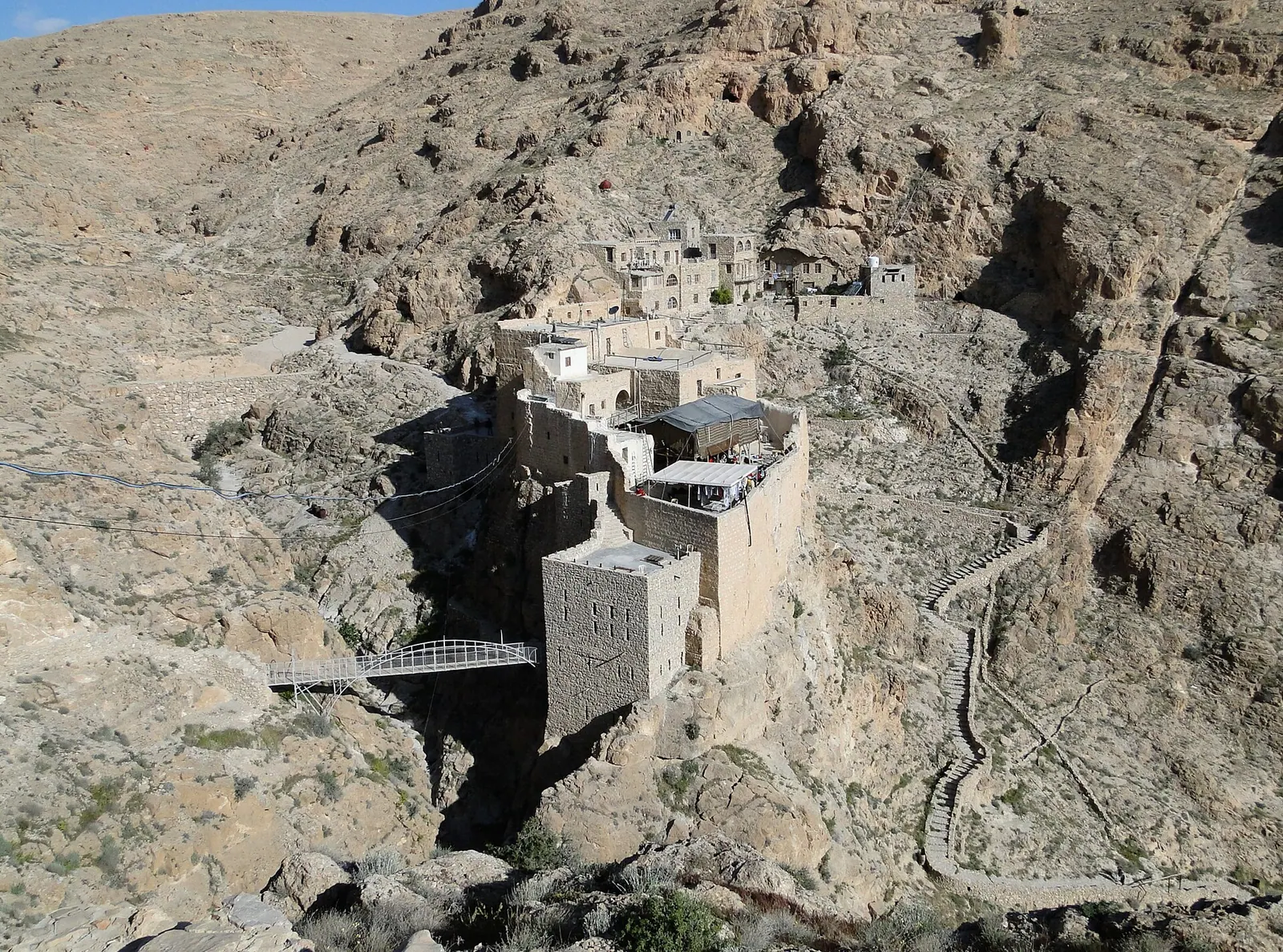
View of the main (and oldest) building of Deir Mar Musa al-Habashi, the Monastery of Saint Moses the Abyssinian, Syria · Photo: Bernard Gagnon · CC BY-SA 3.0 · Wikimedia Commons · Recorded 2010
Monastery of Saint Moses the Abyssinian
Local name: دير مار موسى الحبشي
Deir Mar Musa al-Habashi, the Monastery of Saint Moses the Abyssinian, stands on a rocky promontory above a gorge on the eastern slopes of the Anti-Lebanon, south of Nabk and about 80 kilometres north of Damascus. Its church preserves frescoes from the 11th to the early 13th century. Long abandoned, the monastery was rebuilt from the 1980s and is home to the al-Khalil monastic community of the Syriac Catholic Church.
History
The two oldest surviving structures were probably Roman watchtowers guarding the road from Palmyra to Damascus, and the monastery rests on the foundations of one of them. Manuscript and coin evidence, together with hermit caves in the nearby cliffs, point to a foundation in the 6th century. German Wikipedia gives 586 as the first documentary mention; English Wikipedia cites a 6th-century manuscript describing a “convent of Mushe” east of Natpha in the province of Damascus. Until the end of the 14th century the monastery was the seat of a bishop.
The 11th and 12th centuries were a period of growth: the monastery was enlarged and fortified and the church repeatedly painted. Inscriptions date the rebuilding of the church to 1058. The larger tower was rebuilt in well-dressed masonry in the 12th century, probably after the earthquakes of 1138 and 1157. Another major rebuilding followed in the 16th century; Arabic Wikipedia gives the year 1556.
Sources disagree on when monastic life ended. German Wikipedia says it ceased in the 17th century; English Wikipedia says the monastery was abandoned in the 19th century after intermittent activity from the 15th century, noting a Syriac population at the site in 1838.[1][2][3]
Architecture
The ruined Roman fort was converted into a small basilica, for a long time the monastery's only building; the monks lived in the surrounding caves. The church frescoes were painted between 1058 and 1208 in three superimposed layers, which Arabic Wikipedia dates to after 1058, to 1090 and to 1208. Because parts of the upper layers have fallen away, sections of all three are visible.
The 12th-century rebuilding of the tower, with carefully dressed stone and vaulting on the ground floor, suggests professional masons. The revival brought new buildings: Dair el-Huqab, built using natural caves, for the monks and the goats; the women's house Dair el-Hayek with guest rooms and seminar rooms, under construction since 1998; and an enlarged former garage in the valley.[1][2][3]
Use and significance
For centuries a small group of monks lived here in mountain seclusion. The monastery served as an episcopal seat until the end of the 14th century, after which the see moved to Hama and Mardin and later to Jerusalem and Damascus.
In 1982 the Italian Jesuit Paolo Dall'Oglio came to Syria and to the ruined monastery; in 1984 he began rebuilding it with volunteers. With the deacon Jacques Mourad, now Archbishop of Homs, he revived monastic life. German Wikipedia dates recognition as a monastic community under the patronage of the Syriac Catholic Church to 1991; English Wikipedia dates the refoundation to 1992. Named the “Al-Khalil Monastic Community of Deir Mar Musa al-Habashi”, it is a double community of men and women, and adds hospitality and dialogue to the classic tasks of prayer and work. In 2008 it had seven permanent members, two women and five men, alongside temporary volunteers; German Wikipedia names Jihad Youssef as abbot.
Its focus is ecumenism, especially between Catholic and Orthodox Christians, and Christian–Muslim dialogue, supported by a library. Efforts at self-sufficiency grew into a centre for organic farming in semi-desert conditions. In 2007 two monks from Mar Musa revived the monastery of Dair Mar Elian near Qaryatain.[1][2][3]
Notable features
The frescoes are described as the only full programme of medieval church decoration to survive in greater Syria and as key evidence for the Syrian school of painting. Pottery from the tower is almost entirely 14th-century and includes a piece of Yuan-dynasty Longquan celadon from China. In 2009 Robert Mason of the Royal Ontario Museum found stone circles, lines and tombs near the monastery that he suggested may be Neolithic.
The origin of the name is uncertain. The monastery is dedicated to Moses the Black, an Egyptian Desert Father, but some inscriptions refer to the prophet Moses, and references to Moses the Black begin only in the 17th century, possibly following the arrival of Abyssinian monks in the 15th. German and Arabic Wikipedia tell of a Moses from Abyssinia who lived as a hermit in a cave here.[1][2][3]
Timeline
- 586
First documentary mention of a monastery (foundation assumed in the 6th century).[1][2]
- 1058
Church rebuilt according to inscriptions; first fresco layer begins.[1][3]
- 12th c.
The larger tower is rebuilt, probably after the earthquakes of 1138 and 1157.[1]
- 1208
- 1556
- 1981
All but one room on the upper terrace have collapsed; the chapel still stands.[1]
- 1984–1991
- 1991/1992
Monastic community refounded under the Syriac Catholic Church (sources give 1991 or 1992).[1][2][3]
Gallery
Documented condition
Current condition not documented · as of 1991
In 1981 all but one room on the upper terrace had collapsed; the chapel still stood, its painted stucco peeling, but its roof and ciborium had been burned as firewood. According to Arabic Wikipedia, restoration lasted from 1984 to 1991. The sources contain no more recent information on the condition of the buildings.[1][3]
Visiting
Getting here
Documented ride, stay and transport services in Rif Dimashq:
Nearby medical services
Straight-line distance from this place. Data: OpenStreetMap, as of 2026-10-30. Operating status not verified – call before going.
- Deir Atiya's national HospitalHospital · 10 kmDirections
- Qalamoon HospitalHospital · 12 kmDirections
- المعهد التقاني الطبيHospital · 12 kmDirections
- HospitalHospital · 18 kmDirections
- مشفى يبرودHospital · 18 kmDirections
Sources (12)
- Wikipedia (en): Monastery of Saint Moses the Abyssinian rev. 1362388477 · CC BY-SA 4.0 · 2026-10-30
- Wikipedia (de): Dair Mar Musa al-Habaschi rev. 271686356 · CC BY-SA 4.0 · 2026-10-30
- Wikipedia (ar): دير مار موسى الحبشي rev. 75150204 · CC BY-SA 4.0 · 2026-10-30
- Wikidata · CC0 · 2026-10-30
- Wikipedia (el) · CC BY-SA 4.0 · 2026-10-30
- Wikipedia (es) · CC BY-SA 4.0 · 2026-10-30
- Wikipedia (fr) · CC BY-SA 4.0 · 2026-10-30
- Wikipedia (hi) · CC BY-SA 4.0 · 2026-10-30
- Wikipedia (it) · CC BY-SA 4.0 · 2026-10-30
- Wikipedia (pl) · CC BY-SA 4.0 · 2026-10-30
- Wikipedia (ru) · CC BY-SA 4.0 · 2026-10-30
- OpenStreetMap · ODbL · 2026-10-30
Kirchliche Zugehörigkeit: Syrisch-katholische Kirche (Wikidata P140, en, de, ar übereinstimmend). Quellenkonflikte: Wiederbegründung 1991 (de, ar: Ende der Restaurierung Sommer 1991) vs. 1992 (en); Ende des alten Klosterlebens 17. Jh. (de) vs. Aufgabe im 19. Jh. (en); Namensherkunft: Mose der Schwarze, ägyptischer Wüstenvater (en) vs. abessinischer Fürstensohn (de) bzw. aus Abessinien gekommener Mönch, zuvor im Kloster Mar Yaqub bei Qara (ar); erste Erwähnung 586 (de) vs. Manuskript des 6. Jh. (en). Die en-Zuschreibung dieses Manuskripts an Johannes Chrysostomos ist chronologisch fragwürdig und wurde nicht übernommen. Die ar-Wikipedia nennt den Diakon „يعقوب مراد“, die en-Wikipedia „Jacques Mourad“ – vermutlich dieselbe Person. Mitgliederzahl und Abt sind Stand der de-Wikipedia (2008 bzw. undatiert). Keine UNESCO-Listung. Zum heutigen Zustand und zu Ereignissen nach 2008 enthalten die Quellen keine Angaben; das Schicksal von Paolo Dall’Oglio wird in den Quellen nicht behandelt und daher nicht erwähnt.