
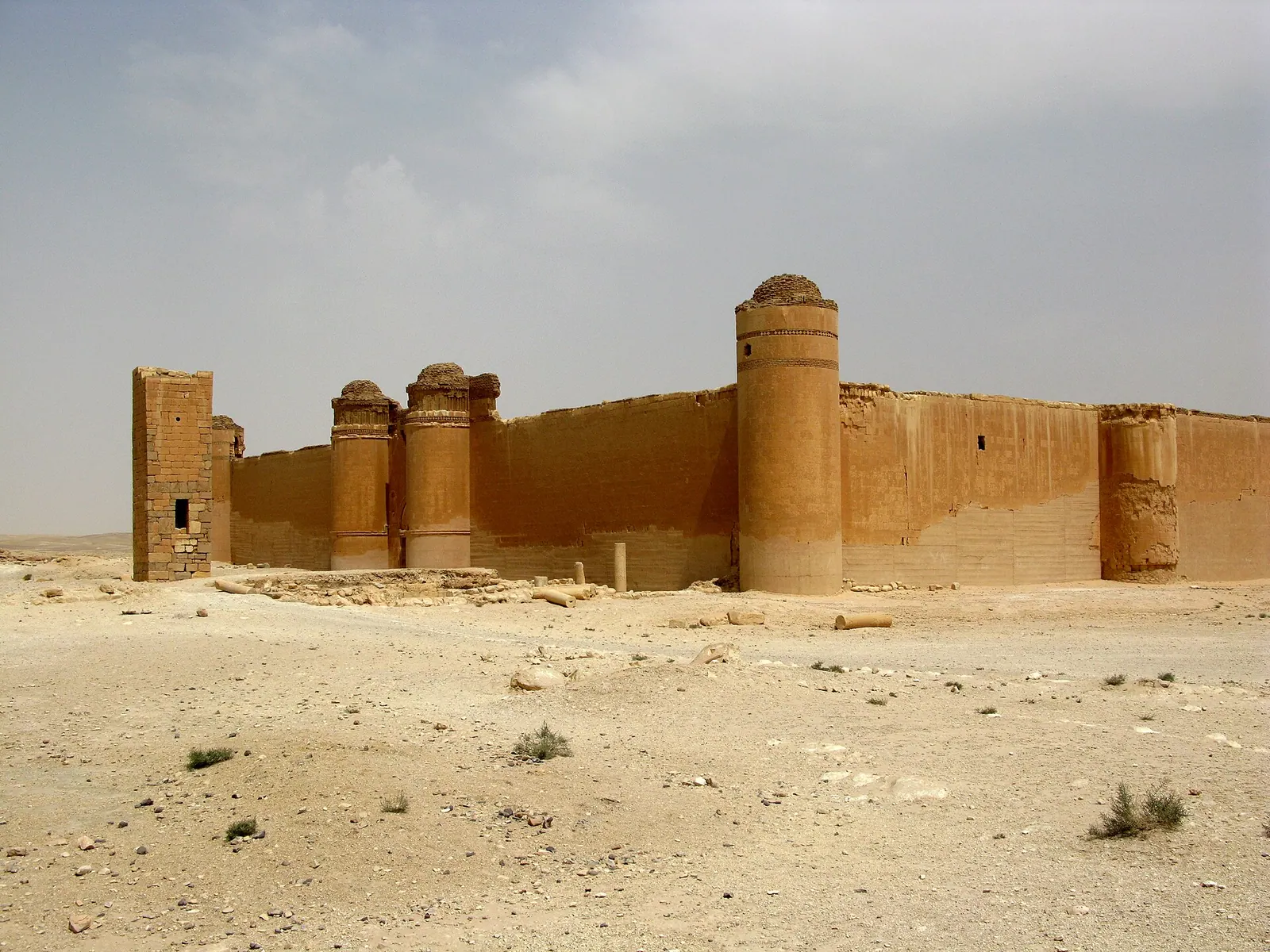
Photo: Vyacheslav Argenberg · CC BY 4.0 · Wikimedia Commons · Recorded 2008
Qasr al-Hayr al-Sharqi
Local name: قصر الحير الشرقي
Qasr al-Hayr al-Sharqi is an Umayyad palace and settlement complex in the Syrian Desert near Jabal Bishri. It is attributed to the caliph Hisham ibn Abd al-Malik and dated to about 728–729, and it counts among the so-called desert castles. The site has been on Syria's UNESCO World Heritage Tentative List since 1999.
History
The dating varies slightly: English Wikipedia gives 728–729, German Wikipedia “before 729” and Arabic Wikipedia the year 110 AH. According to the UNESCO description, an inscription now lost attributed the complex to Caliph Hisham (r. 724–743). It is considered the counterpart of Qasr al-Hayr al-Gharbi, built a year earlier according to English Wikipedia. The sources describe its purposes as hunting and retreat from Damascus, a military outpost and, in German Wikipedia's account, control of Bedouin tribes and trade routes.
The Abbasids continued to use the site; the UNESCO description reports the view that the large palace became the core of a town with oil presses, glass workshops and living quarters in the 10th century. After the capital moved to Baghdad in 762 the site declined; parts were used into the 14th century, at the start of which it was abandoned according to English Wikipedia. Oleg Grabar directed excavations from 1964 – six seasons until 1971 according to English Wikipedia, seven campaigns until 1972 according to German Wikipedia.[1][2][3][4]
Architecture
The complex comprises two palaces: a large one about 160 metres per side and a small one of about 70 metres (UNESCO: irregular, about 60 metres). Both are reinforced by semicircular towers and corner towers. The main gate of the large palace is flanked by two half-towers, and two-storey residential wings surrounded a wide courtyard. The walls are of white limestone that has turned ochre over time, with some buildings of fired brick; according to English Wikipedia, brick and stucco decoration shows Byzantine and Sasanian influence. German Wikipedia states that the columns and capitals are spolia from a Roman building.
A mosque stood between the town and palace walls; German Wikipedia says its minaret still stands about 10 metres high. An outer enclosure wall surrounded gardens and animal reserves; its length is given as 16 km (de), over 6 km (ar) and 7 km (UNESCO). A canal about 5.7 km long brought water to the site.[1][2][3][4]
Significance
According to the UNESCO description, Qasr al-Hayr al-Sharqi preserves its original Umayyad character better than any other desert castle and shows the continuity of pre-Islamic artistic traditions in Syria. Decorated elements were moved to the National Museum of Damascus, and the gate was reconstructed in the Deir ez-Zor Museum.[1][3][4]
Timeline
Gallery
Documented condition
Partly damaged · as of 2017
During the Syrian civil war the site was captured by armed groups in 2013 and damaged by looting and vandalism; the visitors' house was also burgled. The Syrian Army recaptured it on 22 August 2017. The sources contain no later condition report.[1]
Visiting
Getting here
Documented ride, stay and transport services in Homs:
Nearby medical services
Straight-line distance from this place. Data: OpenStreetMap, as of 2026-10-30. Operating status not verified – call before going.
- National Hospital SokhnaHospital · 28 kmDirections
Sources (14)
- Wikipedia (en): Qasr al-Hayr al-Sharqi rev. 1359759034 · CC BY-SA 4.0 · 2026-10-30
- Wikipedia (de): Qasr al-Heir asch-Scharqi rev. 234875252 · CC BY-SA 4.0 · 2026-10-30
- Wikipedia (ar): قصر الحير الشرقي rev. 74726710 · CC BY-SA 4.0 · 2026-10-30
- UNESCO World Heritage Centre, Tentative List: Qasr al-Hayr ach-Charqi · 2026-10-30
- Wikidata · CC0 · 2026-10-30
- Wikipedia (es) · CC BY-SA 4.0 · 2026-10-30
- Wikipedia (fa) · CC BY-SA 4.0 · 2026-10-30
- Wikipedia (fr) · CC BY-SA 4.0 · 2026-10-30
- Wikipedia (hi) · CC BY-SA 4.0 · 2026-10-30
- Wikipedia (it) · CC BY-SA 4.0 · 2026-10-30
- Wikipedia (nl) · CC BY-SA 4.0 · 2026-10-30
- Wikipedia (sv) · CC BY-SA 4.0 · 2026-10-30
- UNESCO World Heritage Centre · © UNESCO (link only) · 2026-10-30
- OpenStreetMap · ODbL · 2026-10-30
Quellenkonflikte: Bauzeit 728–729 (en) / vor 729 (de) / 110 AH (ar) / Wikidata 729 bzw. 730; Grabungen 6 Kampagnen 1964–1971 (en) vs. 7 Kampagnen 1964–1972 (de); kleiner Palast 70 m (de, ar) vs. ca. 60 m (UNESCO); Außenmauer 16 km (de) / über 6 km (ar) / 7 km (UNESCO); Wasserzufuhr: Kanal 5,7 km von einer byzantinischen Kirche bzw. einem Kloster (en, ar, UNESCO) vs. Kanal von der 15 km entfernten Oase at-Taibe (de); Entfernungen: 28 km (en) vs. ca. 10 km (ar) von as-Suchna, 100 km (en, ar) vs. 120 km (de) von Resafa – nicht im Text verwendet. Die UNESCO-Seite enthält einen offensichtlichen Datumsfehler („660 av. J.C – 750“), nicht übernommen. Zustand nur bis 2017 belegt (en-Wikipedia).