
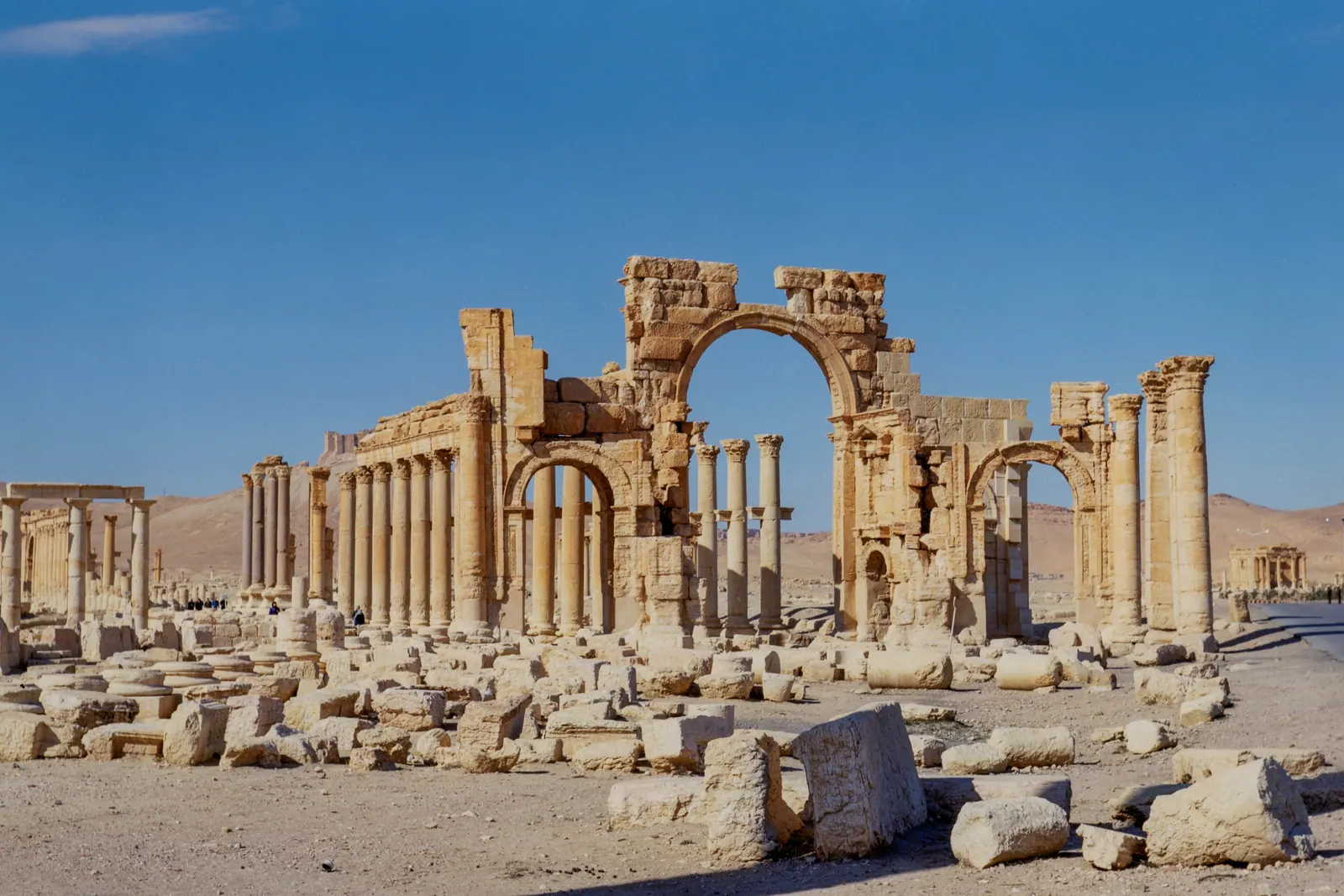
Arch of Triumph of Palmyra · Photo: PhipipY · CC BY-SA 4.0 · Wikimedia Commons · Recorded 1996
Palmyra
Local name: تدمر
Palmyra, known in local and Arabic usage as Tadmor (Tadmur), is an ancient oasis city in central Syria, about 215 km north-east of Damascus. Caravan trade between the first and third centuries AD paid for a monumental townscape that fused Graeco-Roman building forms with local Semitic traditions. UNESCO inscribed the site on the World Heritage List in 1980 and has listed it as World Heritage in Danger since 2013.
History
The place enters the written record around 2000 BC, when a man called a Tadmorean appears in a contract at the Assyrian trading colony of Kültepe; tablets from Mari of the 18th century BC spell the name Ta-ad-mi-ir. The English Wikipedia dates its incorporation into the Roman Empire to around AD 14, under Tiberius, whereas UNESCO places Roman control in the mid-first century AD.
Hadrian visited in 129 and made it a free city; between 213 and 216 Caracalla raised it to a colonia. In 260 the Palmyrene ruler Odaenathus defeated the Persian king Shapur I, and from 270 his widow Zenobia extended Palmyrene rule as far as Egypt. After a renewed revolt in 273 Emperor Aurelian had the city razed; it continued as a smaller garrison town.
Khalid ibn al-Walid took the city in 634. It flourished again under the Umayyads and was devastated by Timur in 1400, after which it remained a village. Henri Seyrig began large-scale excavations in 1929, and by 1932 the inhabitants had been moved to the new village of Tadmur beside the ruins.[1][2][5]
Architecture
The Great Colonnade, about 1.1 km long, formed the main axis from the Temple of Bel in the east to Funerary Temple no. 86 in the west; most of its columns, each about 9.5 m high, date from the second century AD. Along it stood the Monumental Arch, the tetrapylon and the theatre. The agora, 71 by 84 m, adjoined the Tariff Court.
The Temple of Bel paired a Roman colonnaded court with an essentially Semitic plan in which the main shrine stood off the central axis. The Temple of Baalshamin went back to the late second century BC and was largely rebuilt in AD 131. West of the walls, the Valley of the Tombs holds more than 50 tower tombs of up to four storeys; the latest is dated AD 128, after which funerary temples and underground hypogea took their place.[1][2][5]
Use and significance
Cult life centred on Bel, worshipped together with the moon god Aglibol and the sun god Yarhibol. A bishop is attested by 325 and most temples became churches, although the Temple of Al-lāt was destroyed in 385. The Umayyads turned part of the Temple of Bel into a congregational mosque; in 1132 the Burids made its precinct a citadel, inhabited into the 20th century.
The economy rested on farming, herding, taxation and above all the caravan trade linking the Euphrates and the Persian Gulf with the Mediterranean. Merchants paid duties at the Tariff Court, where a bilingual tax law of AD 137 in Greek and Palmyrene was displayed. During the first IS occupation in 2015 the theatre was used for public executions.[1][2]
Notable features
The tariff inscription, found in 1882, was presented to the Russian Tsar in 1901 and is now in the Hermitage in Saint Petersburg. UNESCO emphasises that the ruins, described by travellers in the 17th and 18th centuries, influenced the revival of classical architecture in the West. In August 2015 IS killed Khaled al-Asaad, the retired head of antiquities at Palmyra.[1][5]
Timeline
- c. 2000 BC
A “Tadmorean” is first named in a contract at the trading colony of Kültepe.[1]
- 32
Dedication of the Temple of Bel (AD 32 in the English Wikipedia; the German Wikipedia gives 32 BC).[1][2][3][4]
- 129
- 273
After a renewed revolt Aurelian has the city razed.[1]
- 1400
Devastation by Timur; Palmyra is reduced to a village.[1]
- 1932
Relocation of the inhabitants to Tadmur is completed, freeing the ancient site for excavation.[1]
- 1980
Inscription on the UNESCO World Heritage List.[5]
- 2015–2017
IS occupation; destruction of the Temples of Bel and Baalshamin, the Monumental Arch and the tetrapylon, among others.[1][2][5]
Gallery
Documented condition
Heavily damaged · as of 2026
IS occupied Palmyra from May 2015 to March 2016 and again from December 2016 to March 2017. In 2015 it destroyed the Temples of Baalshamin and Bel and the Monumental Arch; the German Wikipedia also reports six tower tombs blown up in September 2015. In January 2017 the tetrapylon was largely destroyed and the theatre's stage building badly damaged.
The restored Lion of Al-lāt was unveiled in 2017 and is to remain in the National Museum of Damascus. Russian-Syrian teams rehabilitated the Efqa spring area in 2022. After December 2024 UNESCO began working with the Syrian government, ALIPH and the Aga Khan Trust for Culture; according to the English Wikipedia, by June 2026 this work had been limited to surveys and damage assessments.[1][2][5]
Visiting
Getting here
Documented ride, stay and transport services in Homs:
Nearby medical services
Straight-line distance from this place. Data: OpenStreetMap, as of 2026-10-30. Operating status not verified – call before going.
- مشفى تدمر الوطنيHospital · 1.9 kmDirections
Sources (25)
- Wikipedia (en): Palmyra rev. 1382053636 · CC BY-SA 4.0 · 2026-10-30
- Wikipedia (de): Palmyra rev. 271007994 · CC BY-SA 4.0 · 2026-10-30
- Wikipedia (en): Temple of Bel rev. 1380328200 · CC BY-SA 4.0 · 2026-10-30
- Wikipedia (de): Baaltempel von Palmyra rev. 270791519 · CC BY-SA 4.0 · 2026-10-30
- UNESCO World Heritage Centre: Site of Palmyra · 2026-10-30
- Wikidata · CC0 · 2026-10-30
- Wikipedia (ar) · CC BY-SA 4.0 · 2026-10-30
- Wikipedia (el) · CC BY-SA 4.0 · 2026-10-30
- Wikipedia (es) · CC BY-SA 4.0 · 2026-10-30
- Wikipedia (fa) · CC BY-SA 4.0 · 2026-10-30
- Wikipedia (fr) · CC BY-SA 4.0 · 2026-10-30
- Wikipedia (hi) · CC BY-SA 4.0 · 2026-10-30
- Wikipedia (id) · CC BY-SA 4.0 · 2026-10-30
- Wikipedia (it) · CC BY-SA 4.0 · 2026-10-30
- Wikipedia (ja) · CC BY-SA 4.0 · 2026-10-30
- Wikipedia (ko) · CC BY-SA 4.0 · 2026-10-30
- Wikipedia (nl) · CC BY-SA 4.0 · 2026-10-30
- Wikipedia (pl) · CC BY-SA 4.0 · 2026-10-30
- Wikipedia (pt) · CC BY-SA 4.0 · 2026-10-30
- Wikipedia (ru) · CC BY-SA 4.0 · 2026-10-30
- Wikipedia (sv) · CC BY-SA 4.0 · 2026-10-30
- Wikipedia (tr) · CC BY-SA 4.0 · 2026-10-30
- Wikipedia (ur) · CC BY-SA 4.0 · 2026-10-30
- Wikipedia (zh) · CC BY-SA 4.0 · 2026-10-30
- OpenStreetMap · ODbL · 2026-10-30
Geprüft gegen die Quellenpakete (Wikidata, Wikipedia en/de, UNESCO 23). Widersprüche: (1) Weihe des Bel-Tempels – en-Wikipedia (Palmyra und Temple of Bel) 32 n. Chr., de-Wikipedia (Palmyra und Baaltempel) 32 v. Chr. (de-Artikel nennt den 6. April); im Text als n. Chr. geführt, Abweichung offen. (2) Beginn der römischen Herrschaft: en-Wikipedia um 14 n. Chr. unter Tiberius, de-Wikipedia spätes 1. Jh. v. Chr. erobert, UNESCO Mitte 1. Jh. n. Chr. (3) Datum der Zerstörung des Baalschamin-Tempels: de-Wikipedia nennt im selben Artikel 22. und 25. August 2015; Bel-Tempel 30. August (AP-Bericht, de-Baaltempel) bzw. 31. August 2015 (de-Palmyra; UN-Bestätigung per Satellitenbild am 31. August). (4) Monumentalbogen: en-Wikipedia datiert ihn ins 3. Jh., de-Wikipedia nennt ihn „Hadrianstor“. (5) de-Wikipedia meldet einen israelischen Luftangriff auf Palmyra im November 2024 mit schweren Gebäudeschäden; ob die antike Stätte betroffen war, ist aus den Quellen nicht erkennbar – nicht in den Zustandstext übernommen. Die UNESCO-Seite listet eine Aktivität „Emergency Safeguarding of the Portico of the Temple of Bel“ ohne Details. Der Bel-Tempel hat einen eigenen verknüpften Datensatz (Q797481).