
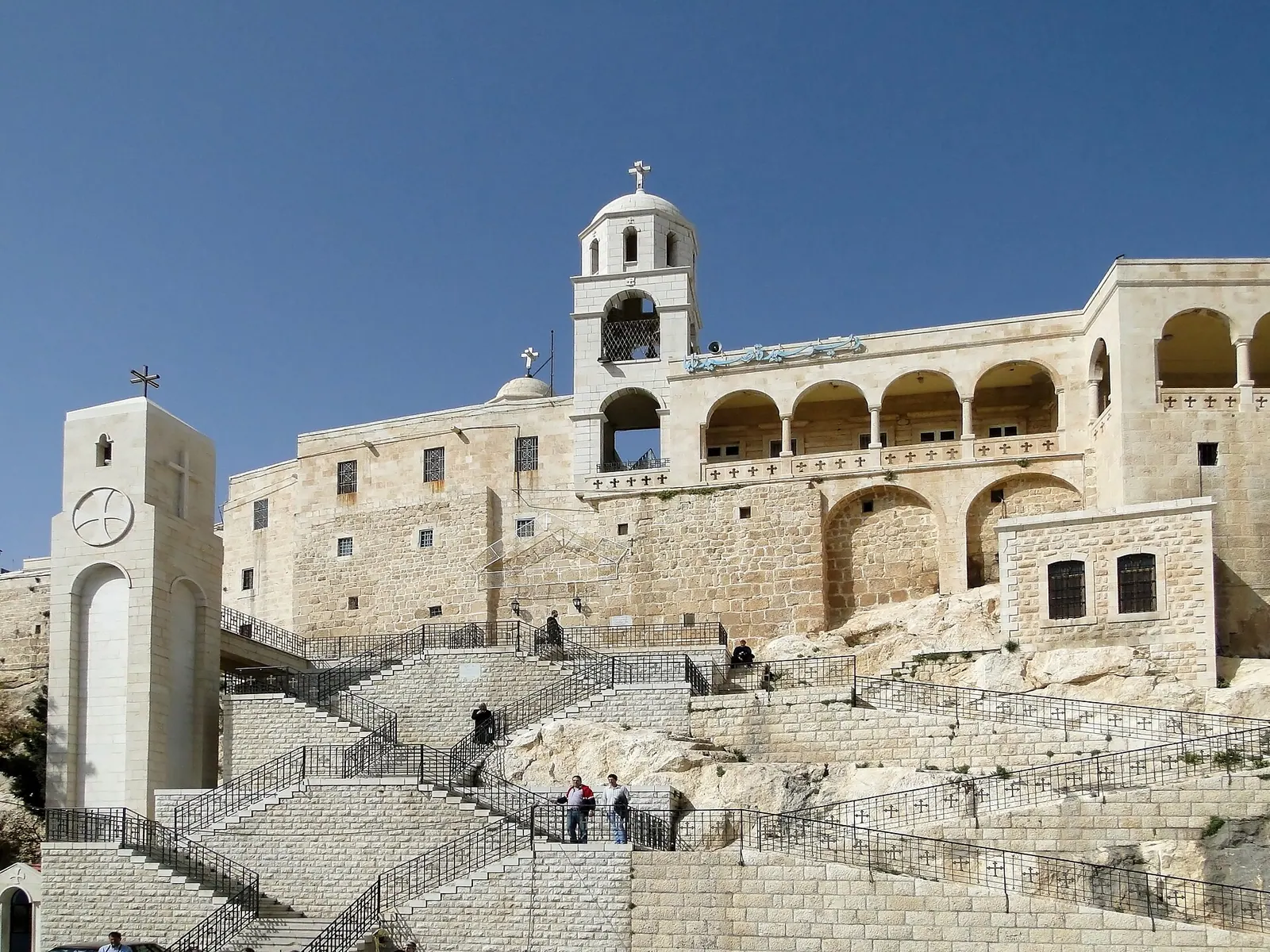
Convent of Our Lady of Saidnaya, Saidnaya, Syria · Photo: Bernard Gagnon · CC BY-SA 3.0 · Wikimedia Commons · Recorded 2010
Our Lady of Saidnaya Monastery
Local name: دير سيدة صيدنايا
Our Lady of Saidnaya Patriarchal Monastery is a Greek Orthodox monastery of the Patriarchate of Antioch in Saidnaya near Damascus, run by an order of nuns. Tradition holds that Emperor Justinian I founded it in 547. It is an important pilgrimage site with an icon of the Virgin attributed to Saint Luke.
History
According to tradition, Justinian I, hunting near Saidnaya, pursued a gazelle up a mountain where the Virgin Mary appeared and told him to build a church; the German and Arabic Wikipedia speak of two visions that set the site and the design. Justinian dedicated the monastery on the Feast of the Nativity of the Virgin. The Arabic Wikipedia adds that monastic life there dates from the 5th century. The sources give the distance from Damascus as 40 km (English) or 30 km (Arabic).
In the Middle Ages Saidnaya was a popular destination, featured in Latin pilgrim accounts including Thietmar's Liber peregrinationis and Burchard of Strasbourg's Itinerarium. These describe the icon as "incarnate" from the neck down and exuding holy oil, a feature absent from Arabic-language sources. An earthquake partly damaged the monastery in 1759, and Druze rebels may have damaged it in 1860. By 1883 only the apse of the medieval church survived; it is incorporated into the modern church. A side room with a painting fragment has been dated to the 12th or 13th century.[1][2][3]
Layout
The main chapel holds numerous icons and a wooden iconostasis in front of the altar. The pilgrimage shrine, separate from the chapel, contains the icon of Mary called Shaghoura ("the Illustrious"), kept hidden behind an ornate niche with silver doors and flanked by later icons. Silver crosses and other ex-votos left by pilgrims hang on the walls. The Arabic Wikipedia mentions a library of hundreds of books and manuscripts.[1][2][3]
Use and significance
Timeline
Gallery
Documented condition
Current condition not documented
All three sources state that the monastery was damaged during the Syrian civil war; the German Wikipedia calls the damage severe. None gives a year or details.[1][2][3]
Visiting
Getting here
Documented ride, stay and transport services in Rif Dimashq:
Nearby medical services
Straight-line distance from this place. Data: OpenStreetMap, as of 2026-10-30. Operating status not verified – call before going.
- Saydeh HospitalHospital · 1.1 kmDirections
- مشفى رنكوس Rankous hospitalHospital · 7.9 kmDirections
- مركز الشفاء الطبيHospital · 9.6 kmDirections
- مشفى التلHospital · 11 kmDirections
- مشفى الزهراءHospital · 12 kmDirections
- Al-hasan hospitalHospital · 12 kmDirections
Sources (10)
- Wikipedia (en): Our Lady of Saidnaya Monastery rev. 1357255218 · CC BY-SA 4.0 · 2026-10-30
- Wikipedia (de): Kloster Unserer Lieben Frau von Saidnaya rev. 243288617 · CC BY-SA 4.0 · 2026-10-30
- Wikipedia (ar): دير سيدة صيدنايا rev. 75927154 · CC BY-SA 4.0 · 2026-10-30
- Wikidata · CC0 · 2026-10-30
- Wikipedia (es) · CC BY-SA 4.0 · 2026-10-30
- Wikipedia (fr) · CC BY-SA 4.0 · 2026-10-30
- Wikipedia (it) · CC BY-SA 4.0 · 2026-10-30
- Wikipedia (pl) · CC BY-SA 4.0 · 2026-10-30
- Wikipedia (ru) · CC BY-SA 4.0 · 2026-10-30
- OpenStreetMap · ODbL · 2026-10-30
Gründung 547 nur als Überlieferung belegt; Wikidata P571 nennt das 6. Jh. (Jahrhundertgenauigkeit). Entfernung von Damaskus 40 km (en) vs. 30 km (ar). Pilger: Christen (en) vs. Christen und Muslime (de, ar). Ausmaß und Zeitpunkt der Kriegsschäden nicht angegeben (en/ar: beschädigt; de: schwer beschädigt). Die de-Angabe, das Kloster sei „dem Evangelisten Lukas gewidmet“, ist offenbar eine verkürzte Wiedergabe der Ikonen-Zuschreibung und wurde nicht übernommen. Die Ikone wird nur nach der Überlieferung Lukas zugeschrieben. Keine UNESCO-Quelle im Paket.