
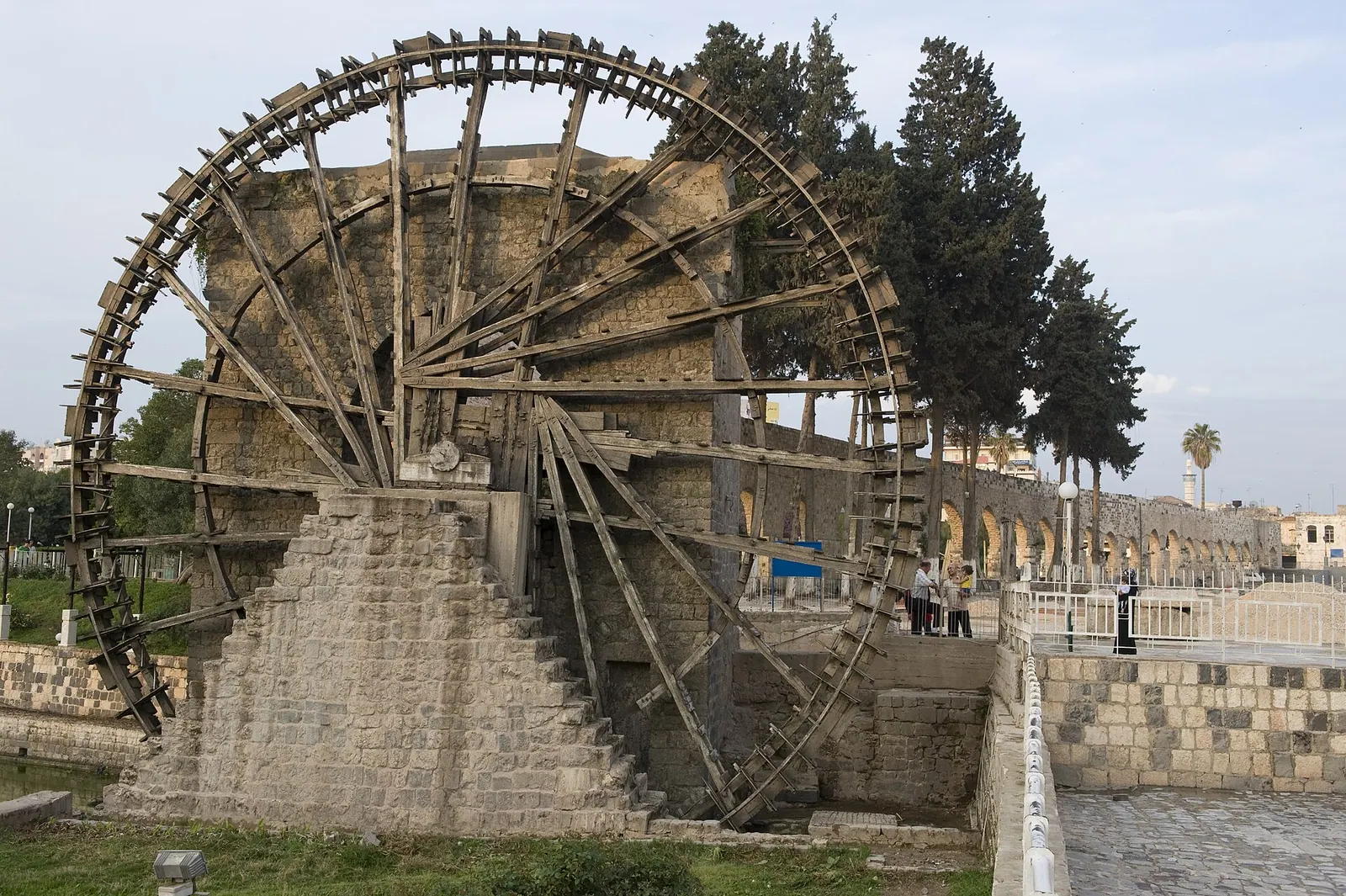
Photo: Dosseman · CC BY-SA 4.0 · Wikimedia Commons · Recorded 2009
Norias of Hama
Local name: نواعير حماة
The Norias of Hama are wooden water-raising wheels on the Orontes that lift river water in boxes set into their rims and tip it into aqueducts carried on stone arches. The two largest, al-Muhammadiya (1361) and al-Ma'muriya (1453), are dated by inscriptions. Syria placed the norias on its UNESCO Tentative List in 1999; they are not inscribed.
History
Their origins are old but hard to date. A mosaic from Apamea, 55 kilometres downstream, shows a wheel strikingly similar to those of Hama; UNESCO and Arabic Wikipedia date it to AD 469, while English Wikipedia places norias near Apamea by about AD 350 on the basis of mosaics and tiles. German Wikipedia gives 469 BC for the mosaic and cites an early 3rd-century account by Emperor Elagabalus of a noria at Apamea.
A 13th-century regional historian reported norias at Hama in the late 9th century, and many were probably working there by the late 12th century. After the earthquake of 1157, Nur al-Din had the water system and norias repaired. Whether the first wheels date from the Roman-Byzantine or the Islamic period remains open. All dates refer to sites: because the timber constantly needs replacing, a well-kept noria is estimated to be entirely renewed about every 15 years.
In the early 20th century Hama and its surroundings had 105 norias. From the 1930s motor pumps displaced them, and from 1960 the Rastan dam lowered the river so that they stood idle for months. By 1970 eight were still working. Six were restored between 1977 and 1981 and seven more in 1988.[1][2][3][4]
Construction and technology
The wheels are undershot, turned by the current pushing against paddles on the rim. Between the paddles sit wooden boxes, half open on one side, that fill at the bottom and empty through a spout into the aqueduct at the top. Depending on the wheel the boxes hold 4 to 12 litres, and output ranges from 50,000 to 200,000 litres an hour. The massive axle is walnut; poplar, pine, oak, apricot and mulberry are named for other parts. Arabic Wikipedia lists some twenty named components.
Each noria sits just below a weir that channels the current to the wheel; sluices adjust its speed, and up to four wheels may share one weir. The water runs into aqueducts on tall stone arches that turned at right angles away from the river and were sometimes several hundred metres long. The system was needed because the Orontes has little gradient and runs deep between high banks; German and Arabic Wikipedia speak of a difference of up to 70 metres.[1][2][3][4]
Use and significance
The norias irrigated fruit and vegetable gardens and supplied the town. According to UNESCO, princes and governors built them for their estates, palaces, mosques, hammams and caravanserais. Al-Muhammadiya fed the Great Mosque about a kilometre away, a hammam, fountains, houses and gardens; al-Ma'muriya served gardens, nine mosques, four hammams and a hundred wells. Most wheels belonged to wealthy landowners, but users shared costs, maintenance and water collectively under set rules.
Seventeen norias survive in the city (Arabic Wikipedia counts 19). They no longer deliver water because their aqueducts have been cut short, but they turn as a symbol of the city, are floodlit during events such as the spring festival, and local youths traditionally ride them. Maintenance still rests with families of specialist noria carpenters.[1][2][3][4]
Notable features
For nearly 500 years al-Muhammadiya was the tallest waterwheel in the world, until the Laxey Wheel on the Isle of Man narrowly surpassed it in 1854. In 2006 the American Society of Mechanical Engineers designated it a Historic Mechanical Engineering Landmark. Its diameter varies by source: 21 metres (English Wikipedia), 22 metres (UNESCO), 27 metres (German Wikipedia).
The Arabic name nā'ūra comes from a verb for a droning sound, after the groaning of the thick wooden axles.[1][2][3][4]
Timeline
- 469
Mosaic from Apamea depicting a noria (German Wikipedia gives 469 BC).[2][3][4]
- after 1157
Nur al-Din repairs the water system and norias after an earthquake.[3]
- 1361
- 1453
- 1960
The Rastan dam lowers the river; the norias stand idle for months.[1]
- 1999
- 2006
Al-Muhammadiya designated an ASME Historic Mechanical Engineering Landmark.[1]
- 8 Aug 2014
Gallery
Documented condition
Partly damaged · as of 2020
During the Syrian army's assault on Hama in February 1982, the wooden wheels reportedly escaped widespread damage, according to a non-government source; whether the aqueducts were demolished then is unresolved. Most norias survived the civil war that began in 2011: a comparison of satellite images of ten sites by the American Association for the Advancement of Science found no major damage by 2014. On 8 August 2014, however, the upper part of the wooden wheel of the al-Ja'bariya noria was burned, its stone base surviving; others were stripped for timber or suffered from neglect. In 2020 traditional craftsmen were restoring al-Muhammadiya, hampered by a lack of funds and of trained craftsmen.[1][2]
Visiting
Getting here
Documented ride, stay and transport services in Hama:
Nearby medical services
Straight-line distance from this place. Data: OpenStreetMap, as of 2026-10-30. Operating status not verified – call before going.
- مستشفى الشققيHospital · 0.2 kmDirections
- Alammori hospitalHospital · 0.6 kmDirections
- مستوصف الباروديةHospital · 0.6 kmDirections
- Albadr hospitalHospital · 0.9 kmDirections
- Hama Matornity and Children's HospitalHospital · 0.9 kmDirections
- مستشفى المركز الطبيHospital · 1.1 kmCallDirections
Sources (12)
- Wikipedia (en): Norias of Hama rev. 1346724211 · CC BY-SA 4.0 · 2026-10-30
- Wikipedia (de): Norias von Hama rev. 256074591 · CC BY-SA 4.0 · 2026-10-30
- Wikipedia (ar): نواعير حماة rev. 76439895 · CC BY-SA 4.0 · 2026-10-30
- UNESCO World Heritage Centre, Tentative List: Les norias de Hama (1291) · 2026-10-30
- Wikidata · CC0 · 2026-10-30
- Wikipedia (es) · CC BY-SA 4.0 · 2026-10-30
- Wikipedia (fa) · CC BY-SA 4.0 · 2026-10-30
- Wikipedia (fr) · CC BY-SA 4.0 · 2026-10-30
- Wikipedia (ja) · CC BY-SA 4.0 · 2026-10-30
- Wikipedia (ko) · CC BY-SA 4.0 · 2026-10-30
- UNESCO World Heritage Centre · © UNESCO (link only) · 2026-10-30
- OpenStreetMap · ODbL · 2026-10-30
Das Quellenpaket enthält keinen Wikidata-Block; Identität, Lage und Klassifikation nur aus den Wikipedia-Artikeln und dem UNESCO-Tentativlisten-Eintrag (Nr. 1291, nicht eingeschrieben) abgeleitet. Quellenkonflikte: Durchmesser al-Muhammadiya 21 m (en) / 22 m (UNESCO) / 27 m (de); en schreibt al-Muhammadiya 120 Kästen zu, UNESCO der al-Maʾmuriya (21 m); Anzahl der erhaltenen Norias in der Stadt 17 (en, de, UNESCO) vs. 19 in fünf Gruppen (ar); Apameia-Mosaik 469 n. Chr. (ar, UNESCO) vs. 469 v. Chr. (de, vermutlich Fehler) vs. Norias „by 350 CE“ (en); de datiert die ältesten erhaltenen Norias ins 11.–12. Jh. und nennt dafür die Ayyubiden (zeitlich ungenau); Umdrehung al-Muhammadiya 1 Minute (en) vs. allgemein 20 Sekunden/2400 Liter (ar). Name der 2014 verbrannten Noria in de als „Gaabariyya“, hier als al-Jaʿbariya wiedergegeben (ar: الجعبرية) – Identität bitte prüfen. Die Angaben zu 1982 stammen laut en aus einer nicht näher genannten nichtstaatlichen Quelle; die politische Bewertung des en-Artikels wurde nicht übernommen. Restaurierungsstand nach 2020 unbekannt.