
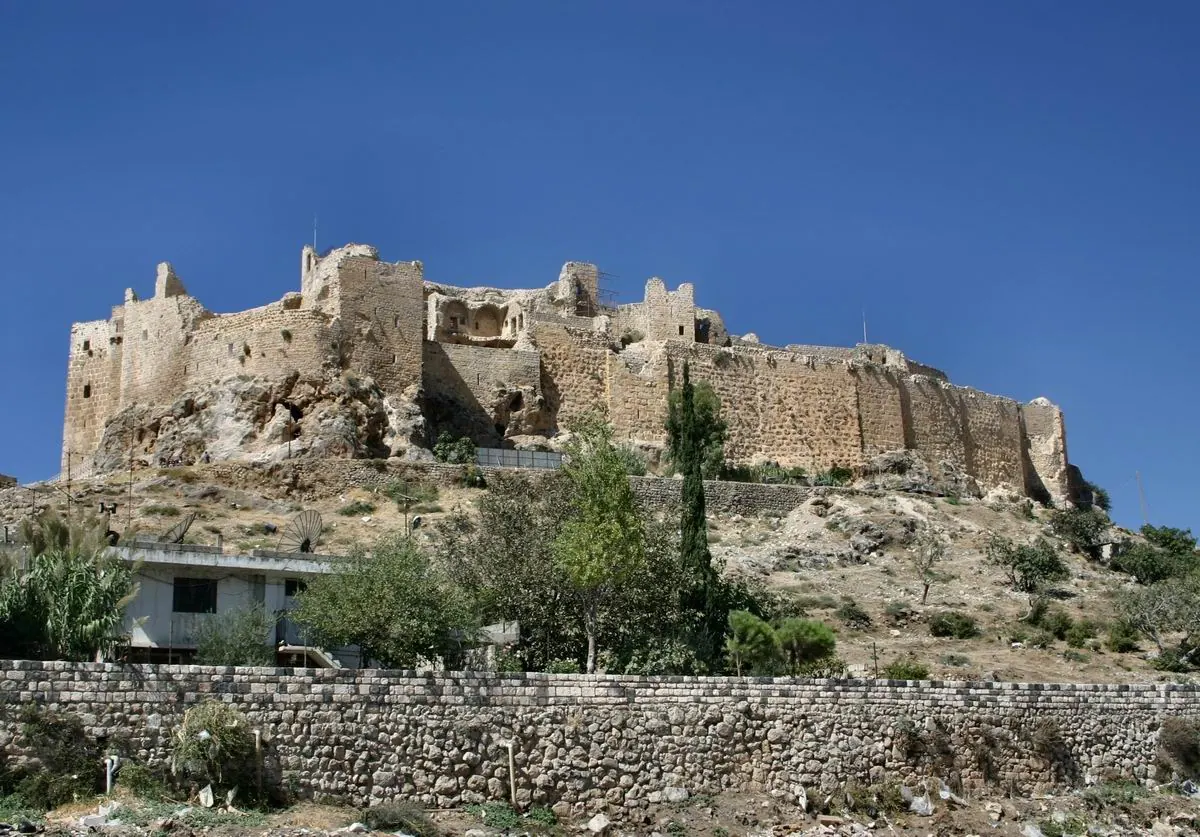
Masyaf · Photo: Mewes at German Wikipedia ( Original text: de:Benutzer:Mewes ) · Public domain · Wikimedia Commons · Recorded 2004
Masyaf Castle
Local name: قلعة مصياف
Masyaf Castle is a medieval fortress in the town of Masyaf in Hama Governorate, about 40 km west of Hama. It stands on a rock platform some 20 m above the surrounding plain and guarded the approach to other Ismaili castles in the coastal mountains. It became famous as the seat of Rashid ad-Din Sinan, the "Old Man of the Mountain", who led the Syrian Nizaris from here from 1166 to 1193.
History
The sources disagree on its origins: the English Wikipedia cites Byzantine foundations, the Arabic a Roman foundation, citing Wolfgang Müller-Wiener. According to the Arabic Wikipedia, the castle changed hands several times in the 10th and 11th centuries – Hamdanids (967), Byzantines (969), Fatimids, Mirdasids – and passed to the Banu Munqidh of Shaizar in 1081.
In 1141 the Nizaris captured the castle from Sanqur, who held it for the Banu Munqidh; Rashid ad-Din Sinan refortified it. From the mid-12th to the late 13th century Masyaf was the capital of a Nizari emirate. Saladin besieged it in May 1176 (the Arabic Wikipedia gives 22 May) but soon concluded a truce. In 1260 Masyaf surrendered to the Mongols (the Arabic Wikipedia says 1258); after the Battle of Ain Jalut the Nizaris recovered it. In February 1270 the Mamluk sultan Baybars took the castle.
In 1808 Nusayris (Alawites) killed the Ismaili emir and seized the castle; the Ismailis recovered it with Ottoman help. In the 1830s the troops of Ibrahim Pasha caused serious damage. During the French Mandate (1920–1946) a French garrison was stationed there according to the Arabic Wikipedia.[1][2]
Architecture
According to the English Wikipedia, most of the present remains date from the 12th-century Nizari building phase, with further layers added by Ismailis, Mamluks and Ottomans. The Arabic Wikipedia describes a roughly square inner keep on the highest, southern part of the rock with corner towers and a courtyard, enclosed by an inner and an outer wall with rectangular and polygonal towers. The main entrance in the south-west corner turns at a right angle through two halls into a 65-metre passage partly cut into the rock. A palace in the upper section bears an inscription dated 1226; after the Mamluk takeover the entrance was extensively rebuilt.[1][2]
Use and significance
The castle controlled trade routes inland and towards Banyas and was the centre of the Syrian Nizaris, also known as the Assassins, in the 12th and 13th centuries. In the late 18th century it became the seat of an Ismaili ruling family; the house of Emir Mustafa al-Mulhim was built in 1793. According to the Arabic Wikipedia it remained inhabited until the Mandate.[1][2]
Timeline
- 1141
- 1166–1193
Rashid ad-Din Sinan rules from Masyaf.[1]
- May 1176
- 1260
- Feb 1270
- 1808
- 2000–2005
Gallery
Documented condition
Restored · as of 2000
Source of the status: https://en.wikipedia.org/wiki/Masyaf_Castle: Aga Khan Trust for Culture restoration from 2000 (current condition not described)
From 2000 the Syrian antiquities directorate restored the castle with the Aga Khan Trust for Culture; the Arabic Wikipedia gives 2005 as completion. Tons of rubble were removed, cement used in the 1980s was replaced with traditional materials, and finds included a passage, baths, cistern channels and 360 coins. The sources contain no more recent dated condition statement.[1][2]
Visiting
Getting here
Documented ride, stay and transport services in Hama:
Nearby medical services
Straight-line distance from this place. Data: OpenStreetMap, as of 2026-10-30. Operating status not verified – call before going.
- مشفى السلمونيHospital · 0.7 kmDirections
- National Hospital MasyafHospital · 0.9 kmDirections
- مشفى مصياف الوطنيHospital · 0.9 kmDirections
- HospitalHospital · 0.9 kmDirections
- مشفى حيالينHospital · 5.3 kmDirections
- Al Andalus University HospitalHospital · 15 kmDirections
Sources (10)
- Wikipedia (en): Masyaf Castle rev. 1364541459 · CC BY-SA 4.0 · 2026-10-30
- Wikipedia (ar): قلعة مصياف rev. 74552107 · CC BY-SA 4.0 · 2026-10-30
- Wikidata · CC0 · 2026-10-30
- Wikipedia (el) · CC BY-SA 4.0 · 2026-10-30
- Wikipedia (es) · CC BY-SA 4.0 · 2026-10-30
- Wikipedia (fa) · CC BY-SA 4.0 · 2026-10-30
- Wikipedia (fr) · CC BY-SA 4.0 · 2026-10-30
- Wikipedia (pt) · CC BY-SA 4.0 · 2026-10-30
- Wikipedia (tr) · CC BY-SA 4.0 · 2026-10-30
- OpenStreetMap · ODbL · 2026-10-30
Keine deutsche Wikipedia; deutscher Name nach Wikidata-Label. Ursprung: byzantinisch (en) vs. römisch, „44 v. Chr.“ (ar) – die Jahreszahl 44 v. Chr. wurde nicht übernommen, da unbelegt und nur in einer Quelle. Mongolen: Übergabe 1260 (en) vs. 1258 (ar). Ibrahim Pascha: en „ägyptischer Gouverneur“, ar „osmanische Expedition“ – im Text neutral als „Truppen Ibrahim Paschas“. Restaurierungsende 2005 nur in ar. Die ar-Bewertung, die Verteidigung der Burg sei „schwach“ gewesen, ist eine Einzelwertung und wurde nicht übernommen. Keine UNESCO-Quelle im Paket; aktueller Zustand unbekannt.