
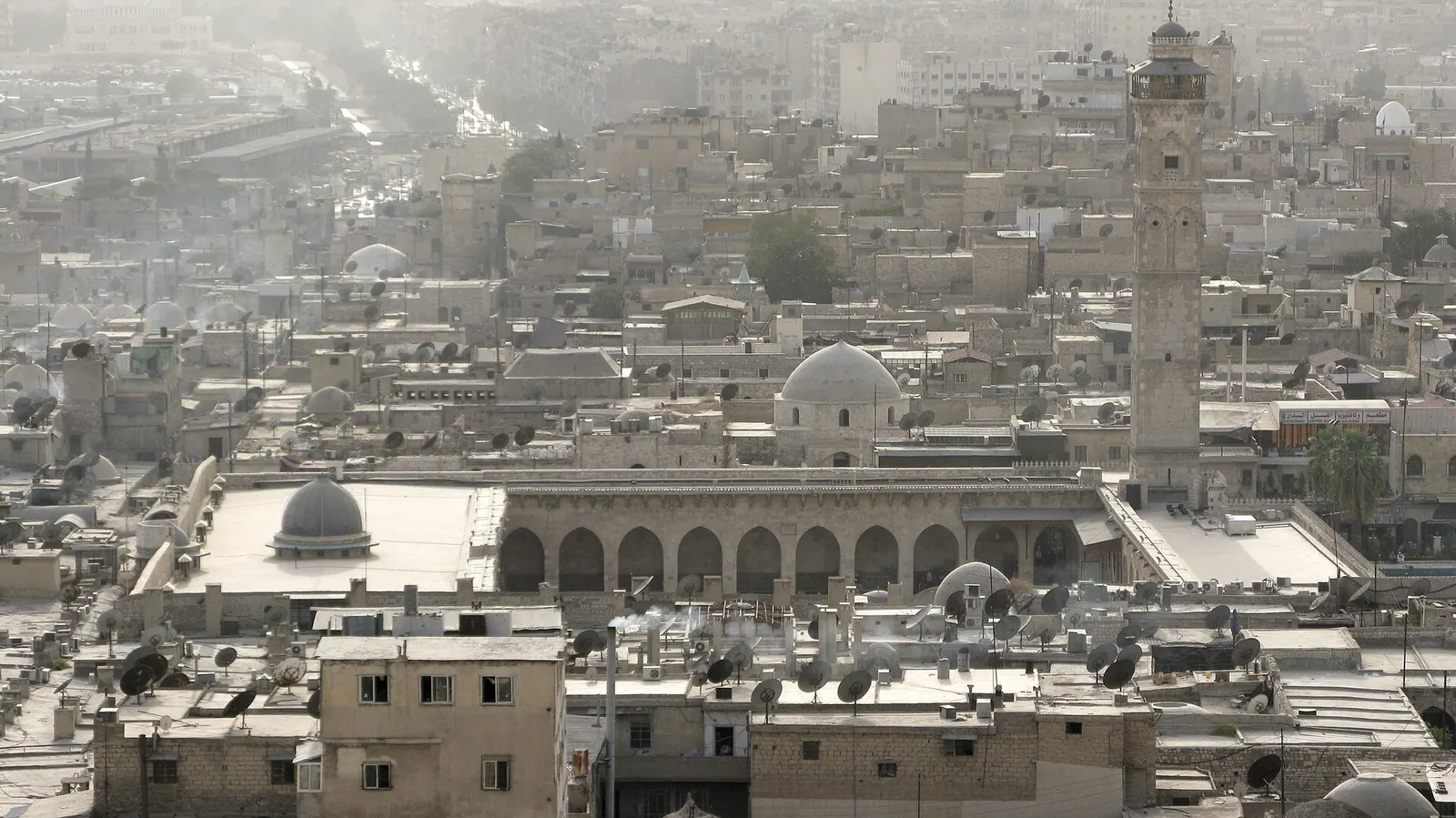
Great Mosque of Aleppo, Aleppo, Syria · Photo: Vyacheslav Argenberg · CC BY 4.0 · Wikimedia Commons · Recorded 2008
Great Mosque of Aleppo
Local name: جامع حلب الكبير
The Great Mosque of Aleppo, also called the Great Umayyad Mosque, is the largest and one of the oldest mosques in Aleppo. It stands in the al-Jalloum district of the Ancient City, a World Heritage Site since 1986, near the entrance to al-Madina Souq. Founded under the Umayyads in the early 8th century, the present building dates mostly from the 11th to the 14th century.
History
The mosque was built on the site of the Hellenistic agora, later the garden and cemetery of the Cathedral of Saint Helena. According to later tradition, Caliph al-Walid I began construction in 715 and his successor Sulayman completed it in 717. Architectural historian K. A. C. Creswell attributes it to Sulayman alone; Jere L. Bacharach considers their brother Maslama ibn Abd al-Malik, then governor of Jund Qinnasrin, the most likely patron.
The roughly 45-metre minaret at the north-west corner was begun in 1090 and completed in 1094 according to the English Wikipedia; its architect was Hasan ibn Mufarraj al-Sarmini. The Arabic Wikipedia dates the start of construction to the Mirdasid Sabiq ibn Mahmud (472 AH). After a great fire, the Zengid ruler Nur al-Din restored the mosque – in 1159 according to the English Wikipedia, after a fire in 1169 according to the German (the Arabic gives the fire as 564 AH/1168). The Mongols razed the mosque in 1260. The Mamluks repaired and altered it; Sultan Qalawun replaced the burnt mihrab in 1285, and a new minbar was made under al-Nasir Muhammad. The courtyard and minaret were renovated in 2003.[1][2][3]
Architecture
Its plan resembles the Umayyad Mosque of Damascus: a large courtyard paved with black and white stone in geometric patterns, surrounded by porticoes, with two roofed ablution fountains and a sundial. The Arabic Wikipedia gives dimensions of about 105 × 77.75 m. The prayer hall to the south has three naves with cross-vaults, a 15th-century minbar, an elaborately carved mihrab and the shrine said to hold relics of Zechariah, father of John the Baptist. The east hall dates to the reign of Malik Shah (1072–1092); the north hall was renovated under Sultan Barquq (1382–1399).
The ashlar minaret had five storeys and carried more relief ornament than any other Islamic-era building in Aleppo except the Shu'aybiyah Madrasa. Brill's First Encyclopaedia of Islam called it "quite unique in the whole of Muslim architecture".[1][3]
Use and significance
Timeline
Gallery
Documented condition
Under restoration · as of 2026
On 13 October 2012 the mosque was seriously damaged in clashes between the Free Syrian Army and government forces. On 24 April 2013 the minaret collapsed; government and opposition blamed each other, and the Syrian Observatory for Human Rights considered collapse from earlier fighting possible. Between 2012 and 2016 parts of the walls collapsed, the prayer hall burned and historic artefacts were lost. According to the English Wikipedia (October 2026), restoration began around 2017; the mosque reopened for Ramadan in March 2025 and fully in October 2026 after 13 years of closure.[1][2][3]
Visiting
Getting here
Documented ride, stay and transport services in Aleppo:
Nearby medical services
Straight-line distance from this place. Data: OpenStreetMap, as of 2026-10-30. Operating status not verified – call before going.
- National HospitalHospital · 0.3 kmDirections
- بناية العطرHospital · 1 kmDirections
- Italian HospitalHospital · 1.3 kmDirections
- Saloum hospitalHospital · 1.3 kmDirections
- مشفى سلومHospital · 1.3 kmDirections
- مشفى ميسلونHospital · 1.4 kmDirections
Sources (20)
- Wikipedia (en): Great Mosque of Aleppo rev. 1380505597 · CC BY-SA 4.0 · 2026-10-30
- Wikipedia (de): Umayyaden-Moschee (Aleppo) rev. 243335235 · CC BY-SA 4.0 · 2026-10-30
- Wikipedia (ar): جامع حلب الكبير rev. 76936213 · CC BY-SA 4.0 · 2026-10-30
- UNESCO World Heritage Centre: Ancient City of Aleppo · 2026-10-30
- Wikidata · CC0 · 2026-10-30
- Wikipedia (es) · CC BY-SA 4.0 · 2026-10-30
- Wikipedia (fa) · CC BY-SA 4.0 · 2026-10-30
- Wikipedia (fr) · CC BY-SA 4.0 · 2026-10-30
- Wikipedia (hi) · CC BY-SA 4.0 · 2026-10-30
- Wikipedia (id) · CC BY-SA 4.0 · 2026-10-30
- Wikipedia (it) · CC BY-SA 4.0 · 2026-10-30
- Wikipedia (ja) · CC BY-SA 4.0 · 2026-10-30
- Wikipedia (ko) · CC BY-SA 4.0 · 2026-10-30
- Wikipedia (nl) · CC BY-SA 4.0 · 2026-10-30
- Wikipedia (pt) · CC BY-SA 4.0 · 2026-10-30
- Wikipedia (ru) · CC BY-SA 4.0 · 2026-10-30
- Wikipedia (tr) · CC BY-SA 4.0 · 2026-10-30
- Wikipedia (ur) · CC BY-SA 4.0 · 2026-10-30
- Wikipedia (zh) · CC BY-SA 4.0 · 2026-10-30
- OpenStreetMap · ODbL · 2026-10-30
Wiederherstellung durch Nur ad-Din: 1159 (en) vs. Feuer 1169 (de) vs. Feuer 564 H./1168 (ar). Minarett-Baubeginn 1090 (en) vs. unter Sabiq ibn Mahmud 472 H. (ar). UNESCO spricht von der „Großen Moschee des 12. Jahrhunderts“. Verursacher des Minaretteinsturzes 2013 umstritten (SANA: al-Nusra-Sprengung; Opposition: Panzerbeschuss; SOHR: möglicher Einsturz ohne Beschuss). Die deutsche Wikipedia nennt eine Komplettrenovierung bis 2005, en/ar eine Renovierung von Hof und Minarett 2003. Wiedereröffnung Oktober 2026 stammt nur aus der englischen Wikipedia (Revision 16.10.2026); Abschluss der Restaurierung nicht belegt, daher Status under-restoration. Deutscher Name: Wikidata-Label „Umayyaden-Moschee“, zur Unterscheidung von Damaskus mit Ortszusatz laut de-Wikipedia-Titel.