
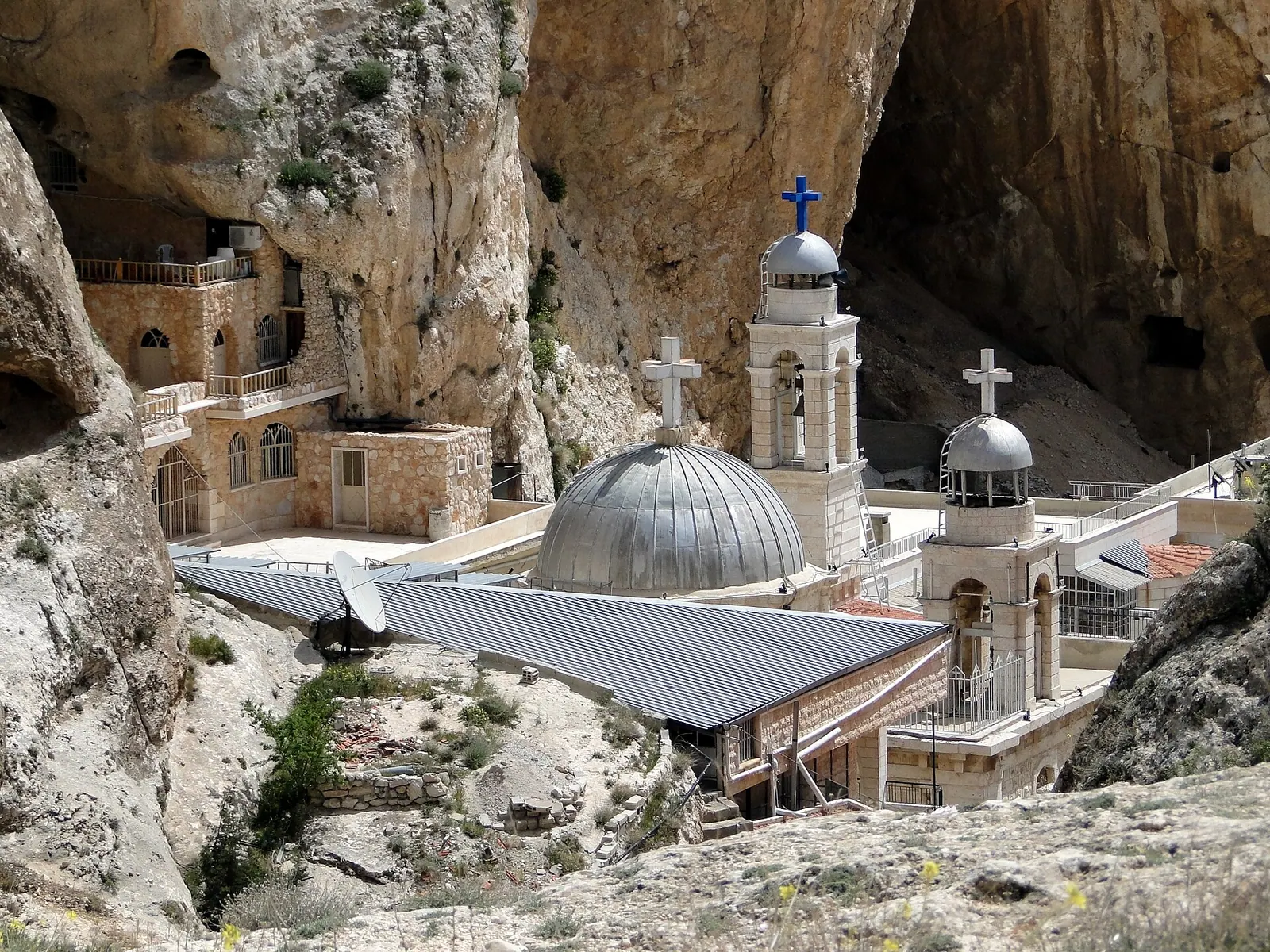
View of the Monastery of Saint Thecla (Mar Takla), Maaloula, Syria · Photo: Bernard Gagnon · CC BY-SA 3.0 · Wikimedia Commons · Recorded 2010
Convent of Saint Thecla
Local name: دير مار تقلا
The Convent of Saint Thecla (Mar Taqla) is a Greek Orthodox convent of nuns in the village of Maaloula in the Qalamoun mountains north-east of Damascus, directly under the Patriarchate of Antioch. It is built around the grotto where, according to tradition, Saint Thecla lived and is buried. The present convent building dates from 1935 onwards.
History
The Qalamoun region became Christian in the 4th century, when the area's first monasteries were founded. According to the chronicle of Mikha'il al-Burayk, the monastery of St Thecla and the church of St John the Baptist were rebuilt in 1756; Wikidata gives this year as the inception date. In 1840 the Russian consul Uspensky recorded four monks there. In 1906 a church was built at the grotto over the remains of an ancient church of unknown date. The guest-house was built in 1934; the convent building was begun in 1935 and received a second floor in 1959.[1][2]
Layout
The ground floor holds a reception room, a refectory and rooms for the sale of religious items; the upper floor holds the nuns' cells, with a kitchen and baking-stone below. A building of 1888 was restored as a patriarchal residence. A ladder at the top of the main building leads directly to the shrine, a rock grotto from the earliest Christian centuries, divided into a sacred spring and two small, recently modernised churches. UNESCO's Tentative List entry describes the heavily restored convent on the escarpment beside a rock shelter with a spring dripping from its ceiling, with a chapel, a cloister and outbuildings.
The icons in the church of St John the Baptist, in the grotto and in the mother superior's wing date mostly from the mid-18th to the late 19th century, including three works by Patriarch Sylvestros and four by Mikha'il Mhanna al-Qudsi of the Jerusalem school. The German Wikipedia notes that these descriptions reflect the state before 2013.[1][2][7]
Use and significance
The second-century Acts of Paul and Thecla present Thecla as a pupil of the Apostle Paul. According to later legend, the rock split open as she fled her father's soldiers, letting her escape into the grotto; the name Maaloula ("entrance") is said to derive from this gap. Healing powers are attributed to the spring. The convent is a major Christian pilgrimage site, and Muslims also venerate the saint. According to the Arabic Wikipedia, the feast of St Thecla on 24 September draws thousands of visitors.
Before the war, according to the English and German Wikipedia, seven nuns and the mother superior Pelagia Sayyaf lived here and ran a small orphanage.[1][2][3][4][6]
Timeline
- 1756
- 1906
- 1935
- 1959
- 3 Dec 2013
- 9 Mar 2014
- Aug 2018
Reopened after repairs.[2]
Gallery
Documented condition
Preserved · as of 2018
From September 2013 Maaloula was fought over. On 3 December 2013 the al-Nusra Front took the village and abducted the mother superior, twelve nuns and – according to the German Wikipedia – two domestic workers; they were held in Yabroud and released on 9 March 2014 in a prisoner exchange. The convent was looted and heavily damaged. After the village was retaken on 14 April 2014 it was renovated and reopened in August 2018. Destroyed icons have been replaced with icons from Russia.[2][4][5]
Visiting
Getting here
Documented ride, stay and transport services in Rif Dimashq:
Nearby medical services
Straight-line distance from this place. Data: OpenStreetMap, as of 2026-10-30. Operating status not verified – call before going.
- مستشفى جبعدينHospital · 4.1 kmDirections
- مستوصف القطيفةHospital · 13 kmDirections
- مشفى القطيفة الوطنيQatif National HospitalHospital · 14 kmDirections
- مشفى القطيفة الوطنيHospital · 14 kmDirections
- مشفى رنكوس Rankous hospitalHospital · 17 kmDirections
- HospitalHospital · 18 kmDirections
Sources (12)
- Wikipedia (en): Convent of Saint Thecla (Maaloula) rev. 1255494558 · CC BY-SA 4.0 · 2026-10-30
- Wikipedia (de): Kloster der Heiligen Thekla rev. 266255196 · CC BY-SA 4.0 · 2026-10-30
- Wikipedia (ar): كنيسة مار تقلا rev. 73460487 · CC BY-SA 4.0 · 2026-10-30
- Wikipedia (en): Maaloula rev. 1380845719 · CC BY-SA 4.0 · 2026-10-30
- Wikipedia (de): Maalula rev. 269033337 · CC BY-SA 4.0 · 2026-10-30
- Wikipedia (ar): معلولا rev. 71994175 · CC BY-SA 4.0 · 2026-10-30
- UNESCO World Heritage Centre, Tentative List: Maaloula (ref. 1299) · 2026-10-30
- Wikidata · CC0 · 2026-10-30
- Wikipedia (fr) · CC BY-SA 4.0 · 2026-10-30
- Wikipedia (it) · CC BY-SA 4.0 · 2026-10-30
- Wikipedia (pl) · CC BY-SA 4.0 · 2026-10-30
- OpenStreetMap · ODbL · 2026-10-30
Ort Maalula (Q740804) und Kloster getrennt; Ortsangaben nur als Kontext. Gründungsdatum: Wikidata P571 1756 vs. Klostergebäude 1935 (en/de); 1756 laut en „wiederaufgebaut“, laut de „erbaut“. Arabischer Name: Wikidata-Label und ar-Wikipedia-Titel lauten „كنيسة مار تقلا“ (Kirche); verwendet wurde die in ar-Ortsartikel und en belegte Form „دير مار تقلا“ – redaktionell prüfen. Zahl der Nonnen: vor dem Krieg sieben plus Oberin (en/de), 2013 zwölf verschleppt (de, en Maaloula) – Widerspruch ungeklärt. Höhe 1600 m (en/de) vs. 165 m in der UNESCO-Vorschlagsliste (vermutlich Tippfehler; nicht verwendet). Entfernung 56 km nur in de. Herkunft Theklas: „Qalamun“ (en Legende) vs. Tochter eines seleukidischen Prinzen (ar). Quelle 3 (ar-Artikel) deckt sich inhaltlich weitgehend mit dem Abschnitt in Quelle 6. Zustand 2018 als „preserved“ eingestuft, gemeint ist instand gesetzt nach schweren Schäden; Originalikonen teilweise verloren.