
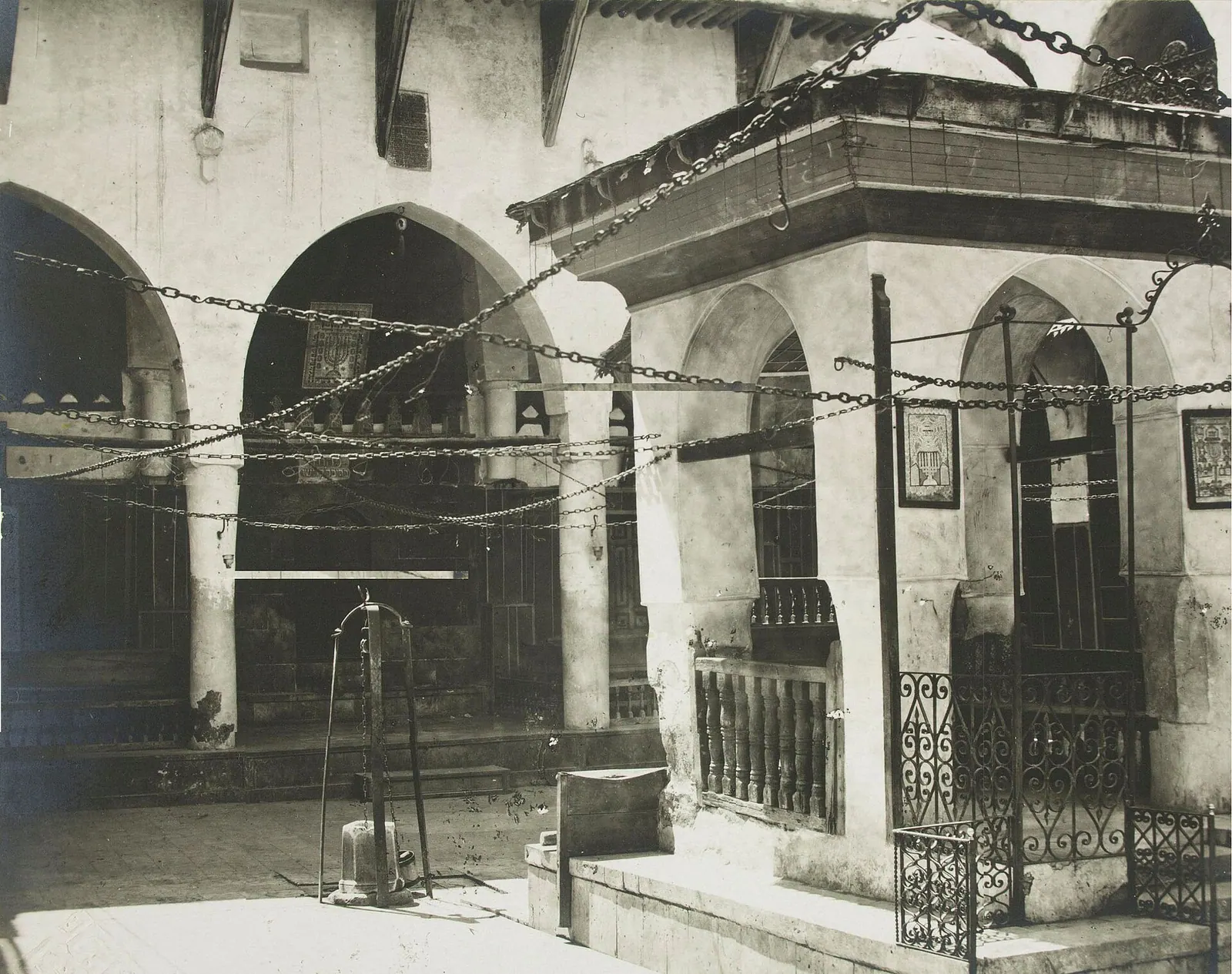
Courtyard of the Central Synagogue of Aleppo · Photo: Herzfeld, Ernst · Public domain · Wikimedia Commons · Recorded 1908
Central Synagogue of Aleppo
Local name: كنيس حلب المركزي
The Central Synagogue of Aleppo, also known as the Great Synagogue, Joab's Synagogue, al-Safra or the al-Bandara Synagogue, is a former Jewish place of worship whose origins may go back to the 5th century CE. It was the principal synagogue of the Syrian Jewish community and for centuries housed the Aleppo Codex. It was burned in the 1947 pogrom and has been under restoration since 2016.
History
According to Jewish tradition as recorded by David Sutton, Joab ben Zeruiah, King David's general, laid its foundations after conquering the city, then called Aram Soba; hence the name Joab's Synagogue. The western wing, the oldest part, is dated to the 5th or 6th century by the English Wikipedia and to the 4th or 5th by the German; the oldest surviving inscription dates from 834. During the Mongol invasion of 1260 the synagogue was one of six designated safe havens according to the English article, whereas the German one states it was turned into a mosque after Mongol damage in the 13th century. It was destroyed during Timur's invasion in 1400 and rebuilt between 1405 and 1418, deliberately on a smaller scale to avoid attention.
After the Ottoman conquest of 1516, economic growth drew Jews from Spain to Syria, and an eastern wing was built where the newcomers could follow their own rites. The building was renovated again in 1855. The traveller Pietro della Valle visited in August 1626, and the scholar Elkan Nathan Adler described it in 1905.
In the Aleppo pogrom of 1 December 1947 the synagogue was looted and burned; the German Wikipedia reports that several worshippers, many of them children, were killed and that pages of the Codex burned. The building lay in ruins until 1990, when the Syrian Jewish community of New York funded a reconstruction completed in 1992. With no Jewish community left in Aleppo, it remained unused and was placed under the jurisdiction of the Syrian government.[1][2][3]
Architecture
The complex had three parts: a western prayer hall, a central courtyard and an eastern wing. The western hall was divided into three aisles by rows of columns; its west wall had seven windows of different designs, and at its centre stood a carved wooden tevah with six steps. At the southern end, facing Jerusalem, were the Middle Ark and the Ark of Moses; the eastern aisle became an entrance hall with the Sealed Ark, above which was the women's gallery.
In the courtyard stood a domed tevah on four columns. The west wall held the Ark of Tekiah, where the shofar was sounded, with a platform reached by nine steps used for circumcisions; the Summer Ark stood against the south wall and a beth midrash occupied the north side. The eastern wing contained the Ark of the Sephardic Jews and the enclosed Cave of Elijah, where the Codex was kept. Seven arks (hechalot) existed across the complex, and a smaller chapel held the genizah.[1][2]
Use and significance
As the community's principal synagogue, the building reflected its make-up: according to the German Wikipedia, the long-established Musta'arabi congregation prayed in the western wing, while the eastern wing served as a study hall and prayer space for the later Sephardic arrivals, known as 'Franks'. In fine weather, especially in summer, the courtyard served as an open-air sanctuary.
For more than five hundred years, since the 14th century according to the German Wikipedia, the community kept the Aleppo Codex here, which the German article calls the oldest manuscript of the Masoretic Hebrew Bible. After the pogrom it was taken to Israel, in 1958 according to the German article. For the later period the German Wikipedia notes that Kaddish and Kohanim prayers were permitted in the synagogue on 1 June 2008.[1][2][3]
Notable features
A distinctive feature was the duplication of places of prayer: each of the three sections had its own tevah and arks, so that hall, courtyard and eastern wing could be used according to season and congregation. The sources give conflicting dates for the eastern wing (15th, 16th or 19th century).[1][2]
Timeline
- 834
- 1260
Mongol invasion; according to the English Wikipedia one of six designated safe havens.[1][3]
- 1400
- 1405–1418
- 1 Dec 1947
- 1990–1992
Reconstruction funded by the Syrian Jewish community of New York.[1][2][3]
- 2011–2015
Damaged again during the civil war under unclear circumstances.[1][3]
- since 2016
Restoration by the Sephardic Heritage Museum; further earthquake damage in 2023.[1][3]
Gallery
Documented condition
Under restoration · as of 2023 Attributed by tradition
During the Syrian civil war the building was damaged again between 2011 and 2015 under unclear circumstances. The Sephardic Heritage Museum began restoration in 2016; the 2023 earthquakes caused further damage. According to the English Wikipedia (revision of July 2026), restoration is ongoing.[1][3]
Visiting
Getting here
Documented ride, stay and transport services in Aleppo:
Nearby medical services
Straight-line distance from this place. Data: OpenStreetMap, as of 2026-10-30. Operating status not verified – call before going.
- نقابة المعلمينHospital · 0.8 kmDirections
- المستشفى العسكري القديمHospital · 0.9 kmDirections
- Saint Louis HospitalHospital · 0.9 kmDirections
- Italian HospitalHospital · 0.9 kmDirections
- Military HospitalHospital · 1 kmDirections
- National HospitalHospital · 1 kmDirections
Sources (9)
- Wikipedia (en): Central Synagogue of Aleppo rev. 1366944525 · CC BY-SA 4.0 · 2026-10-30
- Wikipedia (de): Zentralsynagoge von Aleppo rev. 212322737 · CC BY-SA 4.0 · 2026-10-30
- Wikipedia (ar): كنيس حلب المركزي rev. 76496401 · CC BY-SA 4.0 · 2026-10-30
- Wikidata · CC0 · 2026-10-30
- Wikipedia (es) · CC BY-SA 4.0 · 2026-10-30
- Wikipedia (fr) · CC BY-SA 4.0 · 2026-10-30
- Wikipedia (hi) · CC BY-SA 4.0 · 2026-10-30
- Wikipedia (ru) · CC BY-SA 4.0 · 2026-10-30
- OpenStreetMap · ODbL · 2026-10-30
Widersprüche: Datierung des Westflügels (5./6. Jh. en/ar vs. 4./5. Jh. de); Ereignisse 1260 (Schutzort laut en/ar vs. Umwandlung in eine Moschee laut de); Ostflügel im 15., 16. oder 19. Jh. (en intern widersprüchlich, de 16. Jh.). Die deutsche Fassung (Revision 2021) bezeichnet die Synagoge noch als genutzt und ist in Teilen veraltet; die Lage innerhalb der UNESCO-Welterbegrenze ist in den Quellen nicht belegt.