
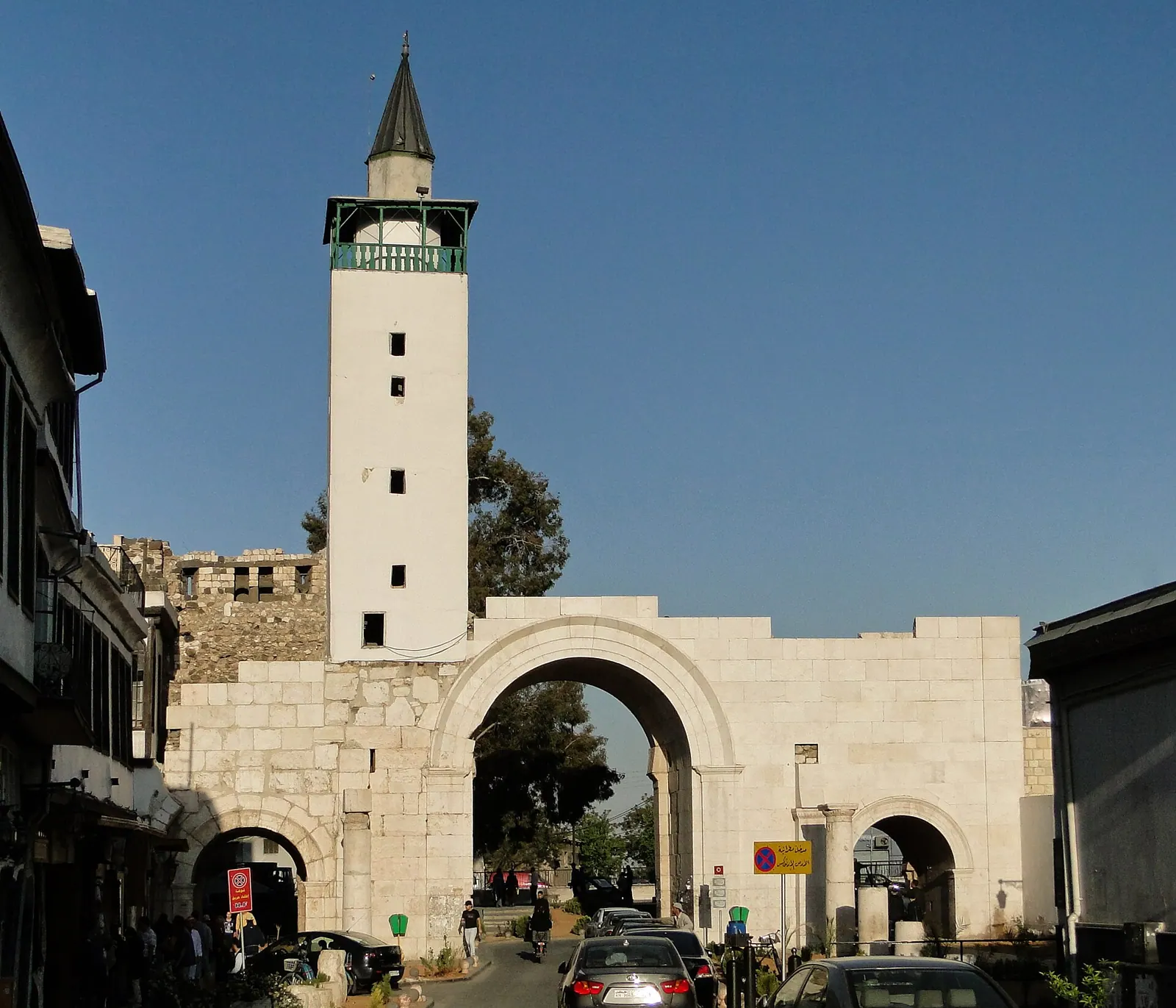
Bab Sharqi in Damascus, Syria · Photo: Bernard Gagnon · CC BY-SA 3.0 · Wikimedia Commons · Recorded 2010
Bab Sharqi
Local name: باب شرقي
Bab Sharqi (“the Eastern Gate”), known in Roman times as the Gate of the Sun, is one of the ancient city gates of Damascus and the only original Roman gate still standing. It marks the eastern end of the Street Called Straight and is the only gate of the old city to keep its original form as a triple passageway.
History
The gate was established around 200 AD and dedicated by the Romans to the sun. According to the Arabic Wikipedia it took its present form under Emperor Septimius Severus and was completed under Caracalla, reportedly on the site of an earlier Greek Gate of the Sun; a relief of a sun disc above the gate no longer exists as a result of restoration work.
According to the German Wikipedia, the commander Khalid ibn al-Walid entered Damascus through this gate on 18 September 634 during the Muslim conquest. Because the triple gate was poorly suited to defence, it was partly walled up in the 12th century under Nur ad-Din; only the central opening was kept and turned into a bent entrance, and a minaret was added. The large façade was restored in the 1960s.[1][2][3]
Architecture
The gate has a large central passage for caravans and wheeled traffic, flanked by two smaller passages for pedestrians. Its decoration is minimal: projecting pilasters are the only ornament. It may have been reinforced by flanking towers. At 26 metres wide it spanned the decumanus, later the Street Called Straight, which had a 14-metre carriageway and two covered colonnades; remains of these colonnades survive inside the gate.[1][2][3]
Use and significance
The Street Called Straight, named in biblical sources, still links Bab Sharqi with the western gate, Bab al-Jabiyah. The surrounding Christian quarter is named after the gate; nearby are the Armenian Apostolic Cathedral of St Sarkis, the Melkite al-Zeitoun Church and, a little to the north, the House of Ananias. UNESCO lists the city walls and gates among the key attributes of the World Heritage property Ancient City of Damascus.[1][2][3][4]
Timeline
- c. 200
Roman Gate of the Sun built (Arabic Wikipedia: under Septimius Severus, completed under Caracalla).[1][2][3]
- 18 Sep 634
Khalid ibn al-Walid enters Damascus through the gate (per German Wikipedia).[2]
- 12th c.
Partly walled up under Nur ad-Din; central opening turned into a bent entrance, minaret added.[1][2]
- 1960s
Restoration of the large façade.[2]
Gallery
Documented condition
Current condition not documented · as of 2009
The sources document no current condition of the gate. They record the restoration of the façade in the 1960s and the loss of the sun relief through restoration work (undated). UNESCO's 2009 statement names the walls and gates as surviving attributes of the old city.[2][3][4]
Visiting
Getting here
Documented ride, stay and transport services in Damascus:
Nearby medical services
Straight-line distance from this place. Data: OpenStreetMap, as of 2026-10-30. Operating status not verified – call before going.
- مركز الإغاثة والتنمي أر دي سيHospital · 0.1 kmDirections
- Saint Louis HospitalHospital · 1 kmDirections
- Al Zehrawi HospitalHospital · 1.3 kmDirections
- HospitalHospital · 1.4 kmDirections
- مشفى الهلالHospital · 1.4 kmDirections
- Red CrescentHospital · 1.4 kmDirections
Sources (14)
- Wikipedia (en): Bab Sharqi rev. 1344544151 · CC BY-SA 4.0 · 2026-10-30
- Wikipedia (de): Bab Scharqi rev. 246753287 · CC BY-SA 4.0 · 2026-10-30
- Wikipedia (ar): باب شرقي (دمشق) rev. 76641231 · CC BY-SA 4.0 · 2026-10-30
- UNESCO World Heritage Centre: Ancient City of Damascus · 2026-10-30
- Wikidata · CC0 · 2026-10-30
- Wikipedia (es) · CC BY-SA 4.0 · 2026-10-30
- Wikipedia (fa) · CC BY-SA 4.0 · 2026-10-30
- Wikipedia (fr) · CC BY-SA 4.0 · 2026-10-30
- Wikipedia (id) · CC BY-SA 4.0 · 2026-10-30
- Wikipedia (it) · CC BY-SA 4.0 · 2026-10-30
- Wikipedia (ru) · CC BY-SA 4.0 · 2026-10-30
- Wikipedia (tr) · CC BY-SA 4.0 · 2026-10-30
- Wikipedia (zh) · CC BY-SA 4.0 · 2026-10-30
- OpenStreetMap · ODbL · 2026-10-30
Widersprüche: (1) Zahl der Tore – en und de: eines von sieben antiken Toren; en zugleich 'eines der acht Tore der Altstadt' – im Text keine Zahl genannt. (2) Bauherr – en/de nur 'um 200'; Septimius Severus/Caracalla und älteres griechisches Tor nur ar ('wie es heißt'). (3) Ein Satz der en-Wikipedia über die Gewährung von Kirchenzugang an Christen hat keinen benannten Urheber – nicht übernommen. Eroberungsdatum 18.09.634 nur de. UNESCO: Tor liegt in der Welterbestätte 'Ancient City of Damascus' (Mauern und Tore als Attribute, Integrity 2009); Einschreibungsjahr steht nicht im Quellenpaket und wurde nicht genannt; die News-Liste nennt die Aufnahme der sechs syrischen Stätten in die Rote Liste am 20.06.2013. Wikidata führt Q3678596 unter P31 (nicht P361); als partOf übernommen, Label nach UNESCO-Seite – bitte prüfen. Koordinaten nicht im Datensatz.