
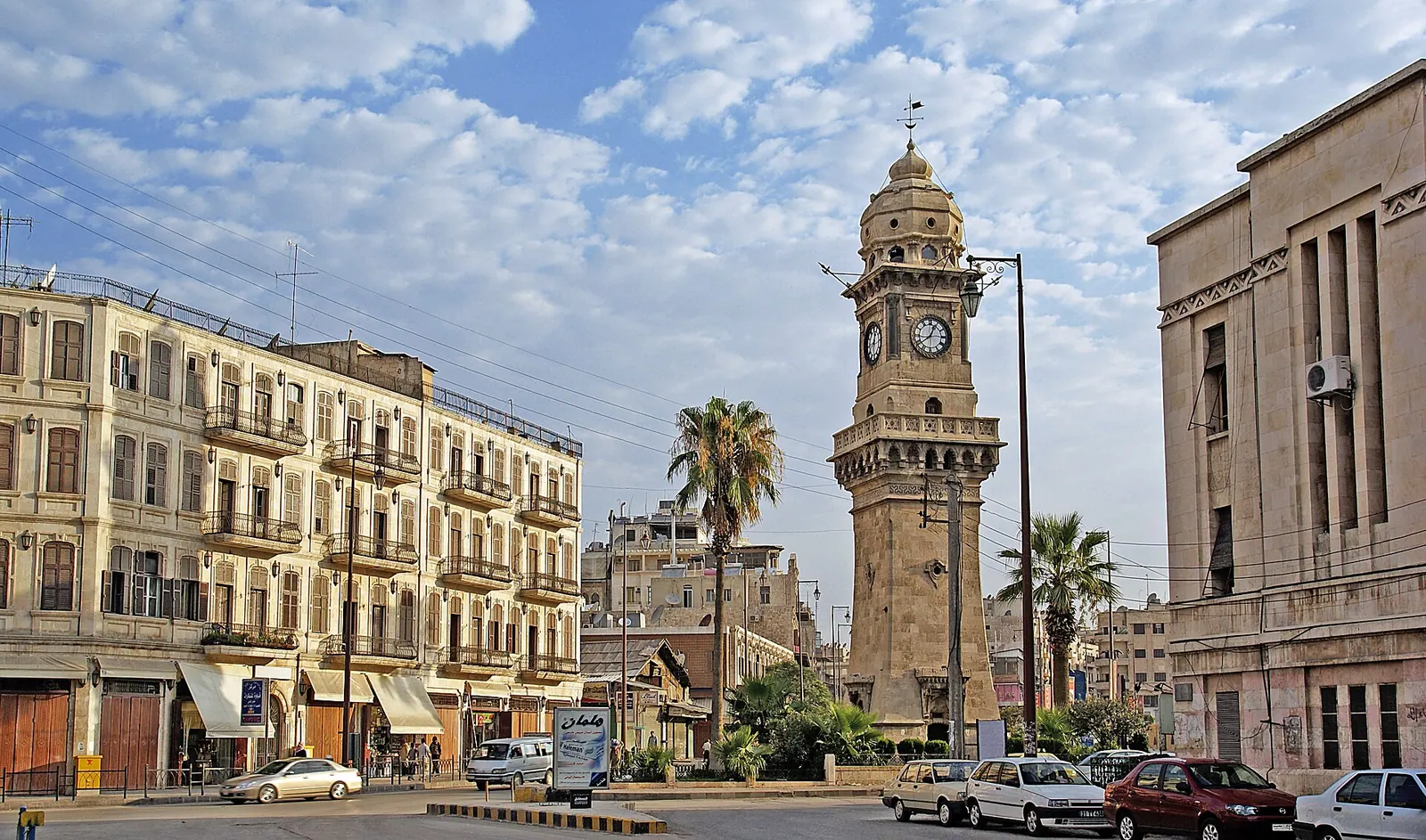
SONY DSC · Photo: Hassan Bushnaq · CC BY-SA 4.0 · Wikimedia Commons · Recorded 2009
Bab al-Faraj Clock Tower
Local name: ساعة باب الفرج
The Bab al-Faraj Clock Tower is one of the main landmarks of Aleppo. It was built in 1898–1899 under the Ottoman governor Raif Pasha near the historic Bab al-Faraj gate and stands opposite the National Library.
History
The Ottoman governor of the Aleppo vilayet, Köse Mehmed Raif Pasha, commissioned the architect Charles Chartier and the engineer Bakr Sidqi; the English and German Wikipedia describe Chartier as French, the Arabic Wikipedia as Austrian. According to the English Wikipedia, Sultan Abdul Hamid II encouraged the project. The Arabic Wikipedia dates the foundation stone to 1898 (1316 AH) and completion, including the surrounding basins, to 1899 (1317 AH). The cost of 1,500 Ottoman lira was met half by donations and half by the municipality.
The English Wikipedia gives 1900 for the inauguration, on the 25th anniversary of the Sultan's accession. According to the Arabic Wikipedia the tower stands on the remains of the Qastal al-Sultan, a fountain built by Suleiman in 940 AH; the Bab al-Faraj gate itself was demolished in 1904, leaving only its southern tower.[1][2][3]
Architecture
Built in an orientalising style, the tower recalls older Islamic minarets but has a wide base and four identical façades whose walls lean slightly inwards. A surrounding balcony with a stone balustrade rests on muqarnas. Above, each side has a round opening with a clock face; according to the Arabic Wikipedia two opposite faces showed Arabic time and two Western time. The top is formed by a superstructure with six windows and a wind vane.[1][2][3]
Timeline
Gallery
Documented condition
Current condition not documented · as of 2025
According to the Arabic Wikipedia, the tower, damaged during the war, was restored and the clock struck again after more than fifty years of standstill, with an English-made mechanical movement installed. The works uncovered finds from several periods and the Roman Hailan channel next to the tower. The sources give no date for these works.[3]
Visiting
Getting here
Documented ride, stay and transport services in Aleppo:
Nearby medical services
Straight-line distance from this place. Data: OpenStreetMap, as of 2026-10-30. Operating status not verified – call before going.
- Italian HospitalHospital · 0.7 kmDirections
- National HospitalHospital · 0.9 kmDirections
- Saloum hospitalHospital · 0.9 kmDirections
- مشفى سلومHospital · 0.9 kmDirections
- مشفى الهلال الاحمر للاطفالHospital · 1 kmDirections
- مشفى الهلال الأحمرHospital · 1 kmDirections
Sources (8)
- Wikipedia (en): Bab al-Faraj Clock Tower rev. 1344700035 · CC BY-SA 4.0 · 2026-10-30
- Wikipedia (de): Uhrenturm (Bab al-Faradsch) rev. 269024094 · CC BY-SA 4.0 · 2026-10-30
- Wikipedia (ar): ساعة باب الفرج rev. 71310161 · CC BY-SA 4.0 · 2026-10-30
- Wikidata · CC0 · 2026-10-30
- Wikipedia (fr) · CC BY-SA 4.0 · 2026-10-30
- Wikipedia (nl) · CC BY-SA 4.0 · 2026-10-30
- Wikipedia (ru) · CC BY-SA 4.0 · 2026-10-30
- Wikipedia (zh) · CC BY-SA 4.0 · 2026-10-30
Widersprüche: (1) Herkunft Chartiers – en/de französisch, ar österreichisch. (2) Fertigstellung 1899 (de, ar) vs. Bau 1898–1899 und Einweihung 1900 (en). (3) Anlass – ar nennt die 25 Jahre seit Thronbesteigung als Zweck des Baus, en als Anlass der Einweihung 1900; nicht nachgerechnet. Zustand/Restaurierung und Wiederinbetriebnahme der Uhr nur ar, undatiert; Kriegsschaden nicht näher beschrieben. Angabe ar, das Uhrwerk stamme vom Hersteller der Big-Ben-Uhr, nicht übernommen (unbelegt, Herstellername fehlt). Kein UNESCO-Bezug im Quellenpaket (die Lage relativ zur Welterbestätte Altstadt Aleppo ist nicht belegt). Keine Relation gesetzt: Wikidata P131 = Q214064 ohne Label im Paket. Deutscher Name nach de-Wikipedia-Lemma/Einleitung; Wikidata-Label de nur 'Uhrenturm'.